





How Do I Get a Podcast?
A Podcast is a like a radio/TV show but can be accessed via the internet any time you want. There are two ways to can get the Dentist Money Show.
- Watch/listen to it on our website via a web browser (Safari or Chrome) on your mobile device by visiting our podcast page.
-
Download it automatically to your phone or tablet each week using one of the following apps.
- For iPhones or iPads, use the Apple Podcasts app. You can get this app via the App Store (it comes pre-installed on newer devices). Once installed just search for "Dentist Money" and then click the "subscribe" button.
- For Android phones and tablets, we suggest using the Stitcher app. You can get this app by visiting the Google Play Store. Once installed, search for "Dentist Money" and then click the plus icon (+) to add it to your favorites list.
If you need any help, feel free to contact us for support.
Subscribe to the Dentist Money™ Show for free
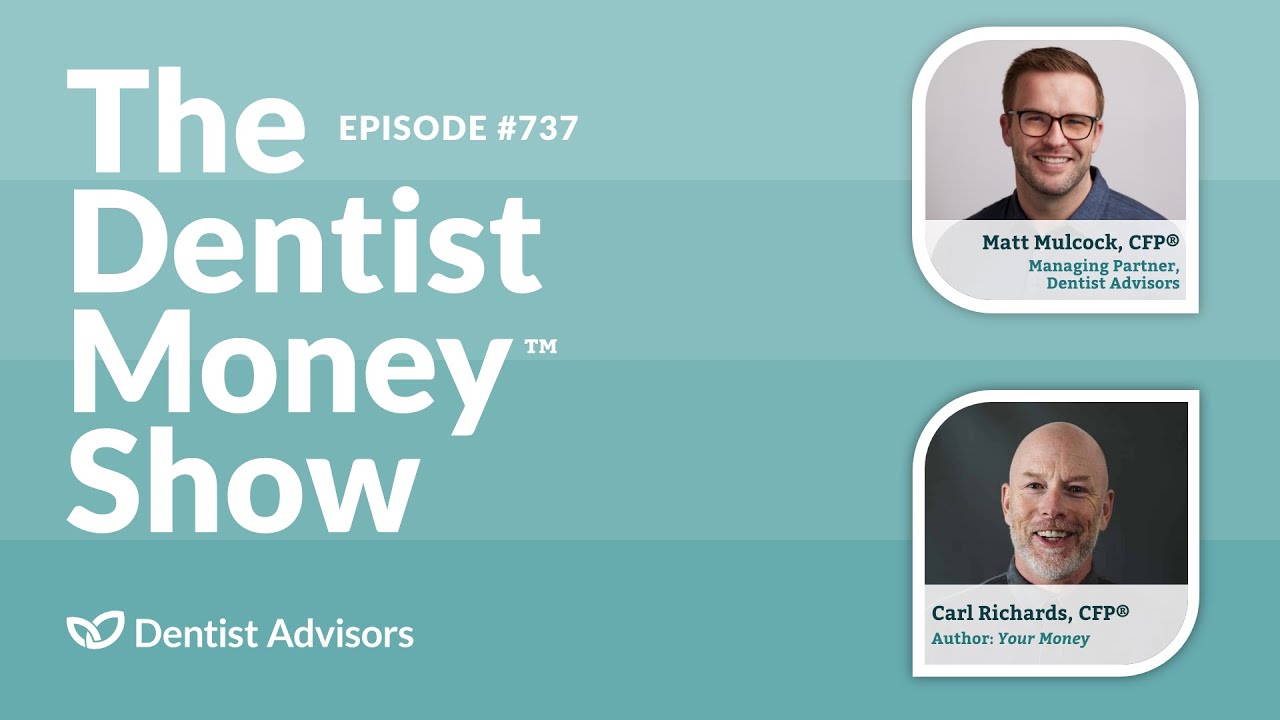
On this episode of The Dentist Money Show, Matt has a conversation with Carl Richards, CFP® about simplifying money and creating clarity in your financial life. Carl shares insights from his latest book Your Money, including how to spark meaningful conversations about money, why managing finances is a lifelong journey, and how attention plays a powerful role in both wealth-building and relationships. They explore the four sources of capital and discuss how personal values shape financial decisions. Tune in to get practical guidance for reducing financial stress and aligning your money with what matters most.
Related Readings
Podcast Transcript
Matt Mulcock: Welcome back to the Dentist Money Show where we help Dentist make smart financial decisions. I am Matt and so excited to be joined by someone who’s becoming a regular of the show and we are so excited about it, but ⁓ multi-time author, former writer for the New York Times, speaker, financial guru, I could go on and on. Carl Richards, thanks so much for being here.
Carl: Matt, really happy to do it. Like just thrilled to have the conversation. Thank you.
Matt Mulcock: Yeah, I think this is number three or four. And again, you’re becoming a regular. are honestly so grateful that we get to talk to you this often. And I got to say, not only thank you for bringing your time here or giving us your time, but as I was preparing for this, ⁓ make it so easy because you have so much content you’ve put out. And in particular today, we’re going to talk about your newest book. ⁓ But it just makes it so easy because we just were talking before we went on. There’s hours and hours and hours of content here for us to discuss. So I guess I wanted to start off with appreciating you for making my job so easy to have this conversation.
Carl: thank you. Yeah, no, it’s I mean, all you have to do is do it for 20 years and that seems to happen like that. It’s like, yeah, yeah. Yeah, exactly.
Matt Mulcock: Yeah. Yeah. Weird how that happens. That’s it. Overnight success. Yeah. Okay. So we want to talk about, again, we’ll use this kind of your book. It’s called Your Money. And it’s really, it’s 101 sketches. If for those of you that don’t know Carl, if you haven’t heard him on our past episodes or just don’t, maybe this is your first time hearing about him. You, Carl, you wrote for the New York Times for about 10 years. Is that right?
Carl: Yeah, we had a column that ran weekly for a decade.
Matt Mulcock: and you became known as the sketch guy.
Carl: Yeah, that was like, it’s funny. That was my editor. It was his idea and it was probably like maybe six weeks in we named it that. And I came home and I told my daughters, I was like, I’m so excited. My column is a name. It’s called the sketch guy. And they were like, ⁓ no. And I was like, wow, I didn’t know that was like the sketchy guy. Right? Like, so anyway, that’s how it got, that’s how it got named. Me neither. They were like, dad, we can’t tell anybody that at school. was like, fair enough.
Matt Mulcock: Yeah. ⁓ yeah. I would have never even thought of that, but that makes sense. Yeah. You’re the sketchy money guy. Yeah. Yeah. Well, you got that because you are and you are a master at this again. And it’s only taking you 20 plus years to master this. But you’ve become such a master at taking seemingly really complex topics and making them so easy to understand through these really elegantly simple sketches. And that’s how you became known. And then you’ve taken those ⁓
Carl: Yeah, exactly. Hmm.
Matt Mulcock: If I remember correctly, you said you had about 800 total over the years, but you were able to narrow them down to about one hundred and one for this book.
Carl: Yeah, I mean, there was whatever 540 or something that ran in the times. then another, I mean, we have a catalog of them now and there’s well over a thousand. yeah, this, this was, this was sort of my attempt to take, I kind of wanted to produce like in my own mind, just to organize my own. This is kind of how the sketches work too. Like when there’s a big pile of stuff in my head. So it’s often like a, maybe a complex subject, like compound interest or Why do I need life insurance? Or I’d like to dive in. It starts out as a very simple, and I’m sure your listeners can all relate, like I just want to open a bank account, you know? And then suddenly you find yourself in all of these options and this nuance and edge cases and what about this and what about that? And I always, whenever I feel that I kind of enjoy getting into that space, but I want to get out as fast as possible. And so I’m always trying to reduce it down to like, I’m paying attention while I’m doing it. Like, what’s the thing that matters? And that’s kind of what we tried to do with this book was like, okay, there’s this big pile of sketches that have to do with money. What would it look like if I created the kind of the definitive catalog if for nobody else, me and maybe my kids, you know, like, and that’s kind of what the attempt was here. So it was actually quite hard to get down to.
Matt Mulcock: Yeah. Yeah, yeah. I’m sure.
Carl: We started with 97 and then I liked 100 better and then I was like, Oh, we got to throw in the gratitude one. So that, was the 101st. Yeah.
Matt Mulcock: Out of the 101, I like it. ⁓ When I think about books, I think most people think about fiction and nonfiction, but I think more broadly than that, feel like there’s what I categorize as kind of like cover to cover books. like a novel is a pretty easy one to cover to cover book. And then there’s other books that I would call like reference books. They’re books that you most likely wouldn’t read cover to cover. You might. But they’re really just more of like, I’m going to come back to this time and time and time again.
Carl: Hmm. Hmm. Hmm.
Matt Mulcock: I’m to come back to certain sections. I’m going to earmark some and read that more often than another. And that’s the category I definitely put this book into. You described this book as a conversational grenade. Tell me more about that and kind of what what what kind of drove you to like to have this be that main purpose of a conversational grenade.
Carl: Yeah. Yeah. And I mean, in terms of that reference thing, that’s really interesting. That was one of the goals was like, can just kind of, and we have a lot of people who play that game. They just pick up the book and flip to a section. And ⁓ we have people who use it as a daily reader. Like they’ll just do one a day. I’ve heard lots of stories like that. I was with my agent, I was calling, I was like, I just want to write a bathroom book. And she’s like, don’t call it that. It’s an airplane book, airplane book. I’m like, okay, fine. So I,
Matt Mulcock: Like George Costanza, it’s like you can’t take the book in the bathroom
Carl: I completely get it. That’s a bad idea. That’s a bad idea. So why not do it on a podcast? ⁓ But ⁓ the idea of a conversation grenade, ⁓ I first heard that term, I don’t know who it originated from, but I first heard that term from Hume Cloud, who’s a kind of artist, writer. He used to draw cartoons on the back of business cards. And he had used that term. And the reason I was… The reason I even decided to write this book, it’s been 11 years since my last one. I was pretty committed to not ever writing a book again and just, I love conversations. I don’t really work in isolation. I love conversations. about a decade ago, there turned out to be a job like that. You could just create podcasts. And so I was focused on that. And I kept getting these notes, these emails. For years, I get these notes like, hey, I saw one of your images online, wherever, in the Times, wherever. and I printed it out and I pinned it to the bulletin board in the break room. And then I noticed something, all these emails, I was always a little disheartened because they never, the next sentence was never, I was so struck by the art. Like it was never like about the art, which is fine. But what it was about was you wouldn’t believe the conversations that started. Like I put one of these up on the fridge and my son asked me about it. I put one of these up at work and my colleague asked me about it. And so was like, that’s interesting. I’d been hearing that for a long time. So then I thought, well, what if we intentionally just like the whole point of the book, everything about the design of the book, every word of the content, was incredibly, I worked harder on this book than anything I’ve ever worked on, incredibly intentional about making it a, just like throw it in a room and watch the conversations break out. And that’s kind of where the term conversation grenade came from. It’s not really a book. It’s a conversation grenade.
Matt Mulcock: Yeah, and I love that it’s a rather topic that, as you mentioned in the intro, money being something that is difficult for people to talk about. So so I love about.
Carl: Yeah, was like an added piece of the puzzle is like, let’s intentionally make a conversation grenade that allows for the types of conversations around money that we should be having instead of the financial pornography, CNBC, wave your hands conversations. We’re not talking about the markets or financial pornography here. We’re talking about the stuff that really matters. And there’s not enough of that. And there’s certainly a lack of tools to facilitate it or make it easy. And so I wanted it to be just like,
Matt Mulcock: Yeah.
Carl: you’d be able to just point to one and say, hey, what do you think of this? Right, like that easy.
Matt Mulcock: So cool. Yeah. And I think, again, the power of your elegance, your elegant, how you make this so elegantly simple is what allows people to be able to have those conversations be more easily had or facilitated because it feels more approachable because, again, it is so simple, not simplistic, but elegantly simple, which I think there’s a power in that for sure.
Carl: Thank you.
Matt Mulcock: So this book is broken down into ten sections. I’ll just read through them really quickly. ⁓ Origins, clarity, mindset, action, investing, stillness, risk, growth, tomorrow and wisdom. And as I said at the beginning, you’ve made this so easy. And because you’re so gracious with your time, ⁓ this is something I think we could do on a relative regular basis. I just kind of go through each section. But I’m curious as we go through this, what was the process for you of narrowing? You said it was really difficult to get down to like 97 or 101 eventually. I can only imagine kind of narrowing down even down to 10 sections of like, what was that process like to get down to like the things that matter being these 10 things?
Carl: Yeah. Yeah, it’s interesting. ⁓ There was a lot about this process that really I didn’t know kind of that I was doing it, but has turned out to be really valuable, at least for me. And that 10 sections was one of them. I didn’t really go into it. I didn’t have that plan. So I got all 101 done. this has a, for people who write, this actually has a really cool benefit. There’s a problem with books, non-fiction books, particularly where there’s a fade. know, like most non-fiction books should really be a 1800 word essay. You know what I mean? Like, and then the problem in the publishing world and authors feel this tension. They’re like, I’ve got an idea. I want to get across. And they’re like, I want to make it, you know, and they, like pack the idea really tight. It’s awesome. And then the publishing world says, no, it has to be 224 pages. And so then you like have to go find and
Matt Mulcock: Yeah.
Carl: all of your listeners have felt this. You’re like, man, that book could have been, I got the point. I got the point. So these were all really short, ⁓ small essays. And then I, but I wrote, you know, like I wrote over the weeks, I kept writing, I’d write five and five and five five five and five. And then when I got done, I was like, man, I wonder how I should organize them. And the good news is they all shuffled at that point. So you didn’t really know, was this the first essay you wrote? Was this the second?
Matt Mulcock: And as I, yeah, could have been an email.
Carl: later? Was this low energy? Was this high energy? It really worked out well. And then I was like, gosh, what could be the organizing principle? And I just played around with them. And that’s how we came up with the, I was particularly interested in, in, you know, words like clarity and action and stillness. it, it, it, none of those are not words you would expect wisdom. You know, tomorrow’s a bit, we hear a lot about that in the, in the financial planning world of like planning for tomorrow. But so that it was just an attempt and it was really like you there’s plenty of them that you could move and I would have no argument with it. You know, like a little bit arbitrary but like feels like it goes there.
Matt Mulcock: Yeah. Sure. Yeah. And again, I think it’s one of the reasons that it makes this book so ⁓ not a bathroom book, but such a such a conversational, easy to reference book because it’s so organized within these 10 categories. So I thought for the rest of our conversation again, with the hopes that you’d be back, that we can kind of just go through. I pulled a couple of concepts from the first portion being ⁓ origins, the first section.
Carl: Yeah.
Matt Mulcock: and just kind of go through these. But before I do, I actually have a quick story that I want to share. I think sets this up kind of for the first, so we go through this section. So this actually pertains to your book. So this last Christmas, so I have four siblings and every Christmas we come together to get a present for my dad, right? So we came together, we did a present for my dad and it’s kind of a gray area at this point for You know, we’re all adults. have our own kids. So it’s kind of a gray area of like, do you get your siblings a gift or not? And sometimes a couple of siblings will other times others will, but it’s not like a sect thing. But this year, this was so easy for me because this, we, gave this book to our clients and I was able to get a copy for myself and I read through it. I was just, it was, I was so struck by it. was like, this is such a perfect gift for, my siblings. So I ended up buying this book.
Carl: Mmm. Mmm.
Matt Mulcock: for my siblings for Christmas. And I wasn’t able to give it to them like on the actual Christmas day. So kind of sporadically gave it to them over the weeks after Christmas. It became kind of a New Year’s gift actually. ⁓ But with my last sibling who I was able to ⁓ finally get with, we were at a family get together again a couple of weeks after Christmas. And my dad was there and we’d already given him his gift, of course. But I handed my sister this present and she opened it. And my dad was sitting nearby and she opened it and I explained the book. I explained who you were and my dad says, well, wait, why didn’t I get one? And I jokingly responded half jokingly, I’d say, but I said, dad, your, money journey is over. Like you, you, you won, you won the game. Okay. So for context, my dad will be 77 this year. He’s been retired for years, easily financially independent.
Carl: Yeah! Right.
Matt Mulcock: doesn’t worry about money at all. He’s done a great job building up, you know, his building up well to be perfectly fine. ⁓ but it’s truly, so I said it jokingly, but not really. And then literally since then it’s been a couple of weeks since it’s actually kind of bothered me. And it’s been in the back of my mind this whole time. And I wanted to bring it to you, the author of this book, like does our money journey actually ever end? Cause it’s It literally has nagged at me ever since, even though I said it as a joke. I don’t think it actually like he could value from this book, even though he is financially independent. I just wanted to get your thoughts on this around our, like our money journey and it ever coming to an end.
Carl: Yeah. Yeah. I like I’d be hesitant to comment on whether your dad could benefit from the book, but to your question, does our money journey end? I would say like that’s one of the most amazing things to me about, you know, the craft of financial planning is that that process never, never ends. But even more specifically about our relationship with money, because I view And maybe it’s helpful to use spending as an example. I use spending just as, it’s literally a practice, the spending practice to see where I’m living in alignment with what I say is important to me. Money is one of the most, it’s the only reason I’ve stayed interested in this industry. I would have been gone a long time ago if it weren’t for the fact, because I don’t care about money. I care about humans and money happens to just be, finally resigned to the idea that it might be the best. Because we don’t necessarily, we can’t quite do this with time, but I even think like our sources of capital, if we include money, time, energy, and attention in that, money is one of the greatest mirrors we have. Like it’s a portal into your soul. I don’t want to be too deep, but where that really shows up is how you use it. Because if you practice how you use it, You’re getting three to five chances a day probably to see is this behavior authentic or not. And sometimes it’s like paying the utility bill. Okay, we’ll give you a pass on that. Right. But, know, what I chose to buy at the grocery store, the gift I chose to dig, the type of car I want to pay for, like all of that. And not to be heavy, just to simply say, and my favorite way to approach this is like, oh, isn’t that interesting? I just spent that much on that. Isn’t it? No shame, no blame. Just isn’t that interesting? Is that, do I really value that? ⁓ I do. Awesome. I want to buy five more. Right? No, I don’t. You know what? Next time I’ll probably pass. Like we do this a lot. I’m shocked at how little we eat out now. And it’s, yeah. And I’m not, this is no value on like, because we have slowly learned and it took a while to unwind this.
Matt Mulcock: You’re saying you and your family.
Carl: Because it’s what you do. Like, let’s stop at Cafe Rio on the way home. It’s what everybody does and we’re supposed to enjoy it. And if you do enjoy it, like awesome. But we’ve slowly learned, we feel more aligned. I gonna say we even feel better when we just come home and make our food at home. Eating out does not play, it doesn’t give us a massive return. Now I know and we both know somebody that loves eating out and gets massive value from it. And he should spend lavishly on that to the degree his budget will allow. And we should cut ruthlessly on that to the degree that we want to. And those are both the right answer. But the only way I found that answer out is by using money as a practice. And so to that point, I think, no, your money journey never ends. Like it’s a constant
Matt Mulcock: Yeah.
Carl: trying to recalibrate, calibrate, get even better about does this reflect who I really am?
Matt Mulcock: Yeah. So well said Carl and that’s that. Yeah. I was going to say I’m buying him a copy as well. but that’s why I think it’s bothered me so much. Cause again, even though I said it jokingly, I was coming from the standpoint, which I think a lot of our clients at Dentist advisors come from, which is the, the only part of the journey that matters is the accumulation of wealth and not once I’ve reached the top of the mountain. Like I think I fell prey to that mindset, which I’ve been doing this now for, you know,
Carl: Your dad needs a copy of the book. Yeah.
Matt Mulcock: almost 15 years, I should know better, which is why it bothered me. And to your point of saying, ⁓ money is just a reflection of who we are and what we value. to that end, yeah, money, absolutely journey. That journey never ends because that would be the end of us reflecting on those things like self mastery and who we are, values and all those things. So it doesn’t end.
Carl: Totally, it’s totally reasonable though. I wouldn’t feel too bad about it, but I think it is an interesting thing that you’ve been thinking about. And I think for your listeners, This comes up almost every time somebody has the sense that they’re gonna be full gas and then one day retire. And then they do it.
Matt Mulcock: Yeah.
Carl: And you think, wait, you’re 57, your life’s not gonna, or you’re 62 or you’re even 60. I mean, the concept of retirement really started when, at a time when retirement age was set at 65, but life expectancy was 63. Right? So like, your life was on average over, your life’s not even close to over now. And then the other thing I’d say about this is like,
Matt Mulcock: Over. Yeah.
Carl: The thing that is absolutely clear from the literature and all the research and then my own anecdotal evidence and at this point, thousands of conversations about it is anytime you think something will end or be finished when you get to the, or you’ll finally be something when you get to something, like I often think of it as like you get to the top of the mountain, you’re gonna just find a void there. And you need to realize that you’re only on the top of the mountain for, you know, You better enjoy the side of the mountain, the bottom of the mountain. Like you better enjoy all of it because you’re only on the top of the mountain for a little bit. You know, the new car, hedonic treadmill is the technical name. It’s like anything you get, it’s going to quickly wear off and it won’t. It’s one of the most puzzling experiences and it’s it leads to a lot of depression. It leads to a lot of angst. It leads to a lot of sadness to be like, I, my whole life was focused on this. And then I got here and realized, geez, what’s it all for?
Matt Mulcock: Yeah. Yeah. I’ve, I’ve, I’ve been kind of kicking around this idea that I think I got from several other people, you Morgan, Housel other people. ⁓ but just kind of this idea that, being, being rich, like having whatever rich means, whatever that means, right. Is not as cool as getting rich and the jerk, like the process of accumulating wealth for most people. think this is my theory right now that The process of getting rich is cooler because it’s an easy proxy for purpose. And then once you’ve reached that, whatever that rich is, you, you, it becomes uncomfortable because then it’s like, well, okay, I’ve kind of reached the top of that money mountain that that was the only thing I was thinking about. But now what?
Carl: Yeah, 100%. And the literature is really, the research is really good around that. The process is the whole thing.
Matt Mulcock: Yeah. Yeah. So there’s a, just to get to the, the section of, again, the section is called origins at the first one. There’s several sketches within this section. I just pulled a few that stood out. mean, again, we could talk about this for hours, but the one that’s the first one that stood out to me was ⁓ titled more than what you do. Can you talk about your friend in New Zealand and them kind of calling you out?
Carl: Yeah.
Matt Mulcock: This is in some ways.
Carl: Yeah, so we moved in 2016, we moved to New Zealand for a year and then it kind of turned into four years and then a year in London. I, because it was relatively abrupt, I had a bunch of speaking engagements and work still scheduled back here. So for that first year, I came back quite a bit and two things occurred. One, I noticed when I… It didn’t take very long before I noticed when I’d come back that like, wow, the water we swim in here is pretty intense. It’s big, it’s fast. And there’s really a lot of benefits for that. I’m not saying there’s anything wrong with it. I’m just saying it’s worth noticing ⁓ in the U.S. And the thing I noticed pretty quickly was that life in the U.S. often work and money
Matt Mulcock: You’re saying in the US. Yeah.
Carl: have become the organizing principles of our lives. you’ll, again, I’m trying not to comment here on whether that’s good or bad, but you’ll like fit the kids in. You know, you’ll fit your health in. You’ll fit sleep, like how many of us say that? Like I’ll sleep when I die. Yeah, you’ll fit sleep in around, that sleep when you’re dead, like my new favorite answer to that is well, you’re gonna get that chance sooner rather than later if you keep that up, right?
Matt Mulcock: Sleep when I’m dead, Yeah, you’re speeding up that process. Yeah.
Carl: Yeah, but the idea here is like, we’ll do work and money and then we’ll see if we can squeeze anything else in. That’s interesting. It wasn’t that way in New Zealand. And one of the ways that showed up, we lived in a small town on the South Island of New Zealand. I would imagine this was slightly different. In fact, I know it was slightly different in Auckland and maybe even Christchurch. But in small town New Zealand, I had a friend that would introduce me to people.
Matt Mulcock: Mm-hmm.
Carl: And after doing that like two or three times, he noticed that I would say, ⁓ what do you do? Because that’s what we ask here in the US. And finally, my friend pulled me aside and was like, mate, why do you ask that question? Like, we don’t ask that question here. Like, let me give you a couple of other questions. Like, hey, what’d you do this weekend? What’s the, what recent holiday have you been on? How are the kids? How was the surfing? How was the fishing? Like, and I realized the whole orientation was different, right? And again, argue if you want about whether that’s good or bad. It was just a different orientation. And I love getting exposed to things where you’re like, ⁓ I could think differently about this. And so that was more than what you do.
Matt Mulcock: Yeah, that’s it’s so interesting. I’ve been thinking about this a lot. This how because I thought about my own life, ⁓ how I would be I would be more comfortable asking a stranger what you do that rather than like, let me ask you this. Was it uncomfortable at first switching?
Carl: Yeah. Yeah. I mean, try this. Like it’s a practice. ⁓ we actually designed a trip. We took eight people on a, it was a spearfishing trip in, in the U S since I’ve been home and we designed, it was off Catalina Island. We designed a trip that specifically, so I invited four people and my friend from California invited four people and he didn’t know none of nobody. Some of my four people knew each other and some of his four people knew each other, but not all of them, but they’d never known each other. And one of the rules of the trip was you could not ask anything about work or what somebody did. And it was shocking. First of all, many times we had to be like, ⁓ like how many times we had to, but then it was shocking how quick, I mean, we weren’t more than five miles off the coast of Long Beach before we were in deep.
Matt Mulcock: Stop? Yeah.
Carl: And I don’t mean the water. suddenly if you remove that, so yeah, it’s hard, like practice it. It’s kind of fun actually to just be like, okay, Friday night I’m going to a party for my friend. And there’s gonna be people I’m gonna meet for the first time. And what else could I ask? Like I’ve started asking like, hey, what’s your story? Just who are you? You know, like how do you know Matt? really, how do you get to know each other?
Matt Mulcock: Yeah. Yeah. Yeah.
Carl: Hey, you look like you might enjoy skiing. Like somebody’s suntan that has goggle lines or something. I don’t know. Like just look for other things and see if it’s actually, once it’s a fun game, to be honest, you find out much more interesting things about people.
Matt Mulcock: The raccoon eyes, yeah. Yeah. Yeah. Well, I’m sure sometimes catch people off guard somewhat because it’s not something they’re normally used to.
Carl: Oh yeah, like here’s another example. I practiced that when I came back home and I decided I was gonna remove the response, oh, so busy. How are you? Oh, busy, so busy. Better than the alternative. You’re like all of, oh, so busy. So I decided I was gonna stop saying that. And somebody was like, hey, how you doing? You busy? When I got back here. And I was like, nah, just, you know, busy enough. And they were like.
Matt Mulcock: Yeah. Yeah. Yeah.
Carl: What’s wrong with you? know, like,
Matt Mulcock: What?
Carl: is everything okay? You’re like, gee, so interesting how deep we’re in that water.
Matt Mulcock: Yeah. Yeah, it’s it is interesting. And again, I’ve been thinking about this a lot preparing for this discussion. And I think there’s kind of two ways to look at it. I want to get your thoughts on this. ⁓ Do we ask this, what do you do question because it is the most important thing. That’s how we frame our identity. Or is there something to this of like almost admitting that that is the most surface level part of who we are and therefore the easiest thing to ask a stranger. about, like, does that make sense? I, sometimes I’m like, because I’d rather ask them what they do. I would far rather, it’s so much more comfortable asking that than like, you know, Hey, what’d you do this weekend? Is it like a random stranger? Tell me about your kids. I wonder if we’re admitting that that is the surface level part of us.
Carl: Yeah. Yeah, look, I don’t think most of us, at least I know I didn’t, like, I don’t think I thought that deeply about it. was just what we did. And that’s fine. And it might be culturally like the easy way into a conversation and that’s okay. And I don’t want to push too hard on it, but, but I think you can find other things. mean, here’s an interesting story. We were on a, on a, a big river trip in New Zealand, sort of like a self-organized group of people we’d gotten together. And there was one kid there in his mid twenties from Germany. And one morning it was two or three days and one morning in the raft, was like, I can’t remember his name, but I was like, Hey, how did you sleep? And he was like, he looked at me really confused, like how did it, and I said, no, no, no, no, no. He went, he started going to this big long thing and I was like, no, no, no, no. This is just a question we ask each other. We say, how did you sleep? You say, fine. I say, okay, we move on. Right? Like, yeah. And so I think there might just be some of that to it, but it’s for, for it is an interesting game. I think it’s pointing to something.
Matt Mulcock: It’s just something we do. Yeah. Yeah.
Carl: And we, as a culture, I think we have gotten a little, we’ve lost the plot. It’s easy to lose the plot. I know it’s easy for me to lose the plot and think that money and work are the things that actually, those are the end of themselves. And I wanna be clear here, like I work as hard as anybody I know. I love hard work. Like it’s not a, I think there’s some of the things around our community specifically here we’re recording in Utah.
Matt Mulcock: Yeah.
Carl: Like a lot of industry, like hard work is a value that we cherish. And in the United States, we consider ourselves, historically at least, like hardworking and there’s been a lot of good that’s come from that. It’s awesome. And striving, I never wanna stop striving. Like I’m never gonna retire. And I hope it’s the least interesting or least important part of my life because my kids are pretty cool. that…
Matt Mulcock: Yeah, yeah.
Carl: The activities I do outside are pretty fun and my community is really great. I kind of want to just talk more about that.
Matt Mulcock: Yeah, your kids are cool. Every time we talk and you share me share stories about your kids, they are they are freaking cool. Yeah, they’re awesome. Yeah. To your point, I also think it probably didn’t go that deep. think a lot of times just question of what do you do is sizing each sizing each other up, maybe status part of it, right?
Carl: They are my favorite people in the world. there’s that piece too, right? And that’s a huge, and again, like even specifically in our community and your audience too, like the dental world. Yeah, there’s a lot of, and look again, competition’s a good thing. we’re, there’s so many of us that genetically, if you didn’t strive and push, you got eaten by a lion, right? Like those things are all important. And yeah, status was important. Position was important.
Matt Mulcock: Yep. Status was everything. Yeah.
Carl: rank, you know, loosely defined was important. And I think those things have served us well. And then I think there’s a place where they there’s places and times, maybe even situations in our lives where they become maladaptive. And we need to just recognize that. Like, we just need to recognize where they’re where those things are useful and where they aren’t and the tension between that and and learn to manage it a bit.
Matt Mulcock: Yeah, I think it’s great. And I think to your point of just it’s not good or bad. It’s just thinking about and approaching it with more intention of like, why do I ask that question? Like, what am I actually trying to get out of that? And are there other questions I could ask? And the last part I’ll mention on this, I think is interesting is we’re so easy. We’re so quick to ask, what do you do about the work portion of our life and identity? But no one would ever say, ⁓ how much do you make doing that? There’s a line, it feels like, that completely is now there from like just the work. But there’s a line between that and the actual getting into the nitty gritty of money.
Carl: Yeah, it’s so funny. Like, can you imagine if, what if you showed up, what if you got dropped into a culture like kind of my experience in New Zealand, but you got dropped into a culture where literally people are like, hey, John, how are you? Nice to meet you. How much do you make? It would be so fascinating. And there, maybe there are cultures like where that happens, you just be like, what? You’re, you’re allowed to do that here? I think that’s kind of how my friend was reminding me of New Zealand. Like, hey, that’s not what we do here. Yep.
Matt Mulcock: Yeah, exactly, you’d never do that. Maybe. Yeah. Yeah. Yeah, it’s interesting. ⁓ Another part of this origin section that I think is so critical to talk about because we talk about this all the time, but the title of this section being the power of order. ⁓ Tell us about if you remember the story of Maxine that you tell in the book.
Carl: Hmm. Sure. Yeah, so there’s something really interesting and I think this is becoming, I don’t know whether the world is more uncertain or not, uncertain and like, I don’t know if it actually is more uncertain, but it certainly, certainly, certainly feels more uncertain. And that’s all that really matters, right? I actually think it is more uncertain, but at the very least it feels like the ground is always shifting beneath our feet. And whenever I feel uncertain, like I noticed that I love to go clean the garage, know, or organize my desk. Like if I feel unmoored, worried, anxious, if I just get my hands on something and organize it, I feel better. And I noticed from this story with Maxine, Maxine got referred to us and her husband had passed away. couple weeks before she got referred to us. Obviously, we didn’t know this until she came in, right? So she comes in with literally, now Maxine’s relationship and whether this is more or less traditional, it doesn’t matter. In Maxine’s relationship, she happened to be the one that took care of 90 % of the stuff, but the 10 % she didn’t take care of was the money side. And her husband took care of the money.
Matt Mulcock: Yep.
Carl: she came with a literally a banker’s box to the first meeting and the banker’s box was just full of unopened half opened, know, know, mail and there was envelopes and big envelopes and small envelopes. was just, it was literally just a mess. And I remember, and I, mean, I can still, I, some, I’ve told the story enough lately that I, like, I don’t always get emotional about it, but I can still feel the emotion of that. Like she, because this was so ⁓ literal, right? She was actually carrying something and it was actually heavy, you know? And often we don’t get the benefit of the visual, but it’s the same feeling. And so I could literally say to Maxine, hey, is it okay if I carry that for you, right? Is it okay if I take that? And we went into my office and we just, I said, is it? You we talked for a while and talked about her husband and… you know, grieve together a bit. And then we just made a deal that like, is it okay between now and when we meet again, I’ll go through this box and I won’t throw anything away, but I’ll just put it in a, I’ll organize it for you. And there will be a section where I’ll call that section like stuff I would have thrown away, but I didn’t want to do it without her permission. So I did that. And I just remember when she came back and I opened a three ring binder and you know, the banker’s box. had gone to a three ring binder. I just remember how palpable the sense of relief was. And I think that’s a lot with money. Like if you’re listening to this and you have some vague idea, some vague feeling that you don’t know how you’re doing, or you could even have some vague, I would imagine there’s somebody listening that’s like, things are pretty, like maybe something’s happened lately that things are pretty bad. We went through a lot of this back in 08, 09. I got so many phone calls from people who were like, I don’t even want to know how bad, right? Like I got calls from strange, cause I was writing pretty prominently about this. got phone calls from strange doctors, dentists who were like, I think I’ve made a huge mistake. And it would be like, well, let’s walk through it. And they’d be like, I, how bad, you know, essentially I was asking how bad is it? I don’t want to know. Well, there was always this sense of huge relief when we went from unknown, scary. to organized, maybe it is bad, but there was still a sense of relief of like, and so that power of order, what I’m pointing to and the reason for that, sorry for the long-winded story, but the reason for that is ⁓ as soon as you get clean the garage, right? Or organize the banker’s box, ⁓ teeny, what you’re feeling from this lack of, this general sense of anxiety, what you’re feeling is a lack of control.
Matt Mulcock: This is great.
Carl: you’re feeling that because you’re reading the news and there is a palpable lack of control around, you know, the economy, things like tariffs, public lands. Like there’s so many things you’re just like, I care about that, but I have no control over it. What you’re getting when you just like, you know, metaphorically clean the garage or clean up or open the statements or sit down with a financial planner is you get some teeny sense of control. And as soon as you get that sense of control, you find it growing a little bit. Like you’d be like,
Matt Mulcock: Yep.
Carl: Okay, okay. And you’re like, what do I do next? Okay, I can do that now. And your sense of control starts to grow just by putting some order around it. That’s what that was about.
Matt Mulcock: So good, Carl. And what I love about what you mentioned is the physical artifact, the actual like heaviness of this box represented the disorganization and the lack of control she was feeling, the weight she was feeling. But I think to your point, I mean, so many dentists, hundreds of dentists every year come to us with some level of this feeling, but not being able to necessarily articulate it. Like I don’t…
Carl: Yeah. Yeah.
Matt Mulcock: think most dentists would come to us and say, you know what, I feel the lack of organization and I’m out of control. They’d say what you’re saying, which is, I’m making good money now and I don’t know where it’s going.
Carl: That one, I just wanted to bring that one up because I know for like a lot of the, a lot of high income professionals that I have spoken to, that is like, I’m, I’m focused, focused, focused, focused, focused, focused. There comes a day when there’s like, there’s starting to be this sense of like, gosh, things are really well. I don’t know what’s going on anymore. That’s a very natural evolution. Like nobody should feel bad about it. That’s just a sign of like, huh. You know, and that question of like, I don’t know where it’s going either from the business or personal or both.
Matt Mulcock: Yep, exactly.
Carl: And the idea of wanting to know where it’s going doesn’t mean you need to start beating yourself up, like, and use the budgeting word. It just means like, gosh, it’d be nice to be intentional about this.
Matt Mulcock: Yeah, totally. And it doesn’t mean you know who you are out there. It doesn’t mean that you’re going to solve that feeling of not knowing where things are going with some specific product, some shiny object, which is what we see. Yes, exactly. And so that’s why I wanted to bring this up is because the power of organization. I mean, you highlighted it so perfectly with the story about Maxine being the foundation of
Carl: Right, most likely a practice and a process.
Matt Mulcock: all decisions and that feeling of control, all of that comes back to cleaning the proverbial garage, right? And getting organized and understanding where things are. And we’ve seen the same thing over and over and over again of almost 20 years of doing this at Dentist Advisors to your point, Carl, of saying they come in scared or the scary unknown of like, I don’t know how I’m doing. And even if it ends up looking quote unquote bad, like they have a negative net worth, let’s say, which for dentists early on in career is so normal. but just the power of them getting organized and saying like, okay, like I see what I’m working with now. 10, a thousand out of a thousand times, they’re feeling good. They’re relieved.
Carl: Yeah, totally. Relieved. ⁓ Yeah, totally, totally. it’s so reliable to me now that I know, like, if I’m feeling anxious, worried, or concerned, all I have to do is go clean something up. And they can be unrelated to what I’m feeling anxious or worried about. It just gave me a sense of control. The desk is clean. I feel a little better. Okay, what next?
Matt Mulcock: Yeah. Yeah. Isn’t that funny how we work? I’m just humans in general. I’m the same way. If you get organized in some area of your life, it brings an immense amount of relief. ⁓ The last part, the last section I wanted to talk about also in this origin section was sketch number six titled The Four Sources of Capital. I love this one because this is something we’ve talked about in some form or fashion over the years. But the four sources of capital that you highlight
Carl: Yeah. Yeah.
Matt Mulcock: The most obvious one to most people is money. Number two is energy. Number three is time. And the number four that I don’t think, I’m glad you put this in here, I don’t think a lot of people separate out this part from time, but number four being attention. ⁓ And most people, as you put in this section, think about investing. They think about money. I’m wondering from your perspective over your whole career and being a professional,
Carl: Yeah.
Matt Mulcock: on many levels of this, why is it do you think most people don’t often think about these other sources of capital when it comes to investing?
Carl: Yeah, it’s it’s is one of my favorite subjects this actual sketch and it came up in another conversation earlier today. I am. I think, maybe I can give you an example that will help. Because I actually think attention is the one that we need to pay the most attention to. And it’s the least obvious at first. And so there’s two things to think about. Number one, the richest people on the planet right now are not railroad titans. They’re titans of attention. Like what they sell is your attention.
Matt Mulcock: Yeah.
Carl: If you think about Facebook and Amazon and even X and Twitter and I would argue even Tesla, right? They’re selling your attention. And so the first thing that does is I don’t know what it means except that it definitely means there must be something valuable there. Like the underlying commodity of attention is really valuable. ⁓ But here’s the example that I like to use. If I take one of my daughters or my son skiing. ⁓ Let’s just say we’re gonna go up to Jackson Hole. We just got back from the Teton. So we’re gonna go up and pay for a day at Jackson Hole. That’s gonna cost me money. Unfortunately, a lot of money. It’s gonna cost me money. It’s gonna cost me some energy. It’s gonna cost me time. And those three, like that’s really obvious. What’s interesting is I could spend the money, the energy and the time and not be there. Like I could be as obvious as on my phone, but even if I didn’t have my phone out, I could be thinking about, if I don’t pay attention, then…
Matt Mulcock: Yeah.
Carl: the experience will be dramatically different for me and for my daughter. We’ve all been through these experiences where you’re like, the person’s there. It may even cost us money to be there. There may be some version of energy because it took time to get there, but they’re not paying attention and you actually leave. It’s not even a neutral experience. You could leave that with that being a negative. My daughter could leave Jackson Hole upset and she’d have a right to. Right? Like, so it would have the opposite effect. So I would argue that the currency that you use for a meaningful relationship and meaningful experiences, the way you pay for a meaningful life is with the currency of attention. The way you pay is by paying attention. Because you could just paint example after example, go to an art museum, it you money, it costs you time, it costs you energy.
Matt Mulcock: Yeah.
Carl: If you’re just wondering about something, you will not have these. So I just think the most important currency, the most important source of capital that we have to invest is attention. The other thing that I think is really fun to play with is like, if you treated energy, time, what if you treated money like time in the sense that at the end of the day, there is none left, right? Like you can’t store it up. You can’t use it another time because one day that will be true. Now, I think that’s bad planning advice, but I’m just saying as a mental model, as a check, as a reminder, one day it will be true. mean, the Egyptians tried to take it with them. It didn’t seem to work very well. I maybe it did work. I guess we don’t know, but one day that will be true. And so I love playing around with those, but attention to me, I could see a day in which
Matt Mulcock: Yeah.
Carl: we had an attention flow statement. Like we have a cash flow statement now. Like I could see a day in which we maybe we have a better way of judging how we use that. What was the return on that? And I would just start thinking that way. Like, how could I invest some attention today? Where am I going to invest it? Cause I can’t invest it all day. But like right now, like I, in this particular moment, I have two screens, three screens in the room. All of them, there is nothing else on them other than like that one over there has the ability to adjust the lighting in the room, but that’s it. I’ve reached a couple of times to toggle over to ⁓ text messages. And every time I go to reach for it, I think, no, right? The conversation would be fundamentally different. You may not even know, but the feeling in the room would be different. The feeling as people listen would be different. if I’m not investing my attention here.
Matt Mulcock: Yeah, I think they’ve even done studies on this of two people in a room and even having a phone in the middle of them on the table. Nothing like neither one just on the just on the table. And to your point, changing the vibes in the room, just having that distraction there of attention.
Carl: the table. Face down. Gosh, it is so important. So important. I can feel now, like I did a podcast that some of us made. There’s a podcast called Faith Matters and I was recently a guest on Faith Matters and I went very intentionally like with, I just want to be deep here. I’m going to pretend like the podcast isn’t even happening and the feeling is so much different than. I’m sorry, I’m gonna pretend like the recording’s not even happening. It’s just a conversation. Feeling is so much different when you really plow your attention into something, your kids will feel it. Sometimes it can be actually too intense and you have to like work your way through it. But I just think that’s why attention is a source of capital. I actually believe it’s the most important source of capital.
Matt Mulcock: Yeah. And I’m curious, Carl, I mean, this is something I’d imagine a skill and a mindset that you’ve cultivated over the years. This is something that I try very hard understanding these different sources of capital. I’d imagine people listening, dentists listening, they’re extremely busy people, really complicated lives of this intersection of their business and their family and all the things. How have you cultivated this over the years? Again, I’d imagine a dentist listening saying, yeah, totally. get that. And then the recording turns off and they’re back to their life doing their thing. How do you cultivate this?
Carl: Yeah. Yeah. the, I mean, I’m used, this is like this, my family would find this hilarious that anybody’s asked me this question. I’m not very good at it. I’ve gotten way better the last five years. And, and I would say the only answer to that is practice. And it really helps, although it’s really hard to get someone, even a spouse to point out when you missed it. But man, I wish I could go back to, you know, like these moments when a kid has a question and you just brush it off. Like there is nothing, like my wife’s so good at this. Like when the phone rings, she’s in the middle of something and she sees all of our kids are out of the house, but let’s say it’s one of our daughters that’s living somewhere else. She sees that, almost universally, she will just be like, she almost has a posture shift. Like maybe even a physical like, okay, get that off me, cause I’m here.
Matt Mulcock: Yeah. Yeah.
Carl: And I think just practicing that, like, and money is a great place to do this. remember specifically, I’m just looking out the window, I remember specifically driving down this road when my son was young and I could see him in the rear view mirror and the neighbors right there had bought a water ski boat. And my son said, ⁓ we’ll just use the Jones family. That’s not their name. The Jones must be rich. And I remember saying, that’s none of our business. And then luckily I looked up in the rearview mirror and I saw this really puzzled book just like, and money, politics, sex, and religion are the things that we say that about. it’s not, but can you think of four things? I can’t think of anything more important than my kids being able to talk to me about those four things. And so that I think now of that as a signal, which is like, it’s, if it’s basically if it’s anything, but if it’s anything about though, it’s like,
Matt Mulcock: Yeah.
Carl: game on. Like it’s sort of like Super Bowl. Like wake up. Like to me it’s like wake up. This can’t, you can’t think of anything more important than what’s about to happen. And it’s going to feel mundane, but it’s the compounding impact of your attention over time that builds the kind of relationships that when your kids are older and adults and they’ll call and say, can I just talk to you for a minute? Right? Like don’t we all want that? Like, what would you want more? You know? And so I’ve got another friend, last story, I’ve got a friend named Jerry who’s a really busy ⁓ executive coach to entrepreneurs and just an amazing human. And he’s like, it doesn’t matter what meeting I’m in. It doesn’t matter who I’m with. If my phone rings and it’s one of my kids, I pick it up and I just say, hey, I’m in a meeting, are you good?
Matt Mulcock: Yeah.
Carl: Can I call you back in 20 minutes or do we need to talk now? And he has found actually that that’s been helpful. He didn’t do it for this reason. He did it for him and his kids, that relationship. But he’s found it’s actually been helpful to all his other relationships. Because people are like, I know that’s his priorities and he lives his priorities. So anyway, enough about that. But that’s why I think attention is so important. So the answer to your question is practice. And don’t beat up on yourself.
Matt Mulcock: Yeah. Number one. I think it’s great. think the last part. Yeah.
Carl: shoot, I missed it. Okay, get it. Every day, almost every day I’m like, shoot, I missed it. I’ll get better tomorrow.
Matt Mulcock: Yeah. Yeah, yeah, speaking of parenting, think my ⁓ unofficial motto of parenting, speaking of screwing up is, ⁓ man, I could have handled that better. And then I’ll we’ll try again tomorrow.
Carl: Yeah, I told my wife, yeah, exactly. I told my wife the other day that if nothing else, my kids will have had modeled the ability to screw up and apologize for it and never stop apologizing for it. Yeah.
Matt Mulcock: Yeah, love that. Show the repair. Yeah, it’s incredible. The last part of this too, Carla, I wanted to get your thoughts on of just, again, you talk about in the book and I see this firsthand is it’s really easy to see ⁓ investing. Like the money part of investing is just, it’s easy. It’s visual, it’s salient, it’s numbers on a screen. We can see progress. But ⁓ I think you alluded to this of just like, The critical part of like, a, just being aware of the other sources of capital, think is huge energy, time and attention and how that balances out with, with money. ⁓ but just the trade-offs between the four things, like how have you kind of seen that play out in your life of, man, I’m spending a lot of money on this thing, but it’s going to give me energy back or help me be more, have more time or how have you kind of seen that play out in your life of this balancing act of these trade-offs of capital?
Carl: Yeah, that’s a really great question. ⁓ I think the, I really settled into the idea that like, that tension holds bridges up. so tension between competing values is good. And it’s been helpful to me to finally, because I always saw that as a fight. In fact, there’s one line in the book that if I had to do all the work for this book all over again to get this one line that I learned while writing the book, it’s one of those things, and I would do it again. if not for this one. I almost feel like I could take the entire book and just release one line. And the one line is, your values are not at war, they’re in conversation. And that shifts from saying like, okay, this may feel, this tension is the whole thing. Like we talked about earlier, this tension I’m feeling between time. Sometimes a lot of the people that I spend time with now have more money than they have time or energy.
Matt Mulcock: Love that.
Carl: So they might use their money to buy back time. It’s a really high quality investment. Some people might have more time than they have money and they may use that time to volunteer in the community. And so I think, and that’s gonna change from person to person and it’s gonna change from periods of life and it’s never gonna be stagnant. And I think there’s a reason we use words like currency and cashflow is these things aren’t stagnant. The moment we try to dam them up, I think we create problems beyond a certain level of storing. When we try to store any of these sources of capital beyond a certain level, and I don’t know what that certain level is, but when we try to store beyond a certain level, suddenly you start to feel like energetically it’s off. And I think you can just pay attention to that. Like, gosh, right now, man, I mean, it’s so funny. Like lot of high-income professionals, You know, there’s this caged lion effect that I hear doctors refer to a lot, like after residency. And ⁓ sometimes you can be like so frugal that you’re missing the whole point of like, guys, what if I just paid some, I was up on the roof the other day, like in our roofs, this side of the house, the roof’s really high. I had the ladder out and I was up like 30 feet cleaning out the drains and my wife came out and was just like, bro, like. That’s a tear. I was like, yeah, but I don’t want to pay. And she’s like, you don’t want to pay somebody? I’m like, you’re right. You’re right. Like somebody with a little more expertise, you know, that most like, like a bad idea. Like that’s an example. Like I’ve got a buddy who pays for meals three days a week. Somebody comes to the house, cooks the meals, stores them in the fridge. And you’re like, that’s so obscene. No, it’s not. Right. Because they’ve figured out a value and they may have a trade off over here.
Matt Mulcock: Yeah.
Carl: Maybe they bought a cheaper car because of it. Maybe they like didn’t go to like whatever. But if you value those things, just learning to feel the tension between time, money, energy and attention and how you’re investing it will show up as a signal. It’s not a problem to be solved. It’s not a problem to be solved. It’s just a thing to start paying attention to.
Matt Mulcock: Yeah. So true. think, yeah, this idea of they’re crazy for that is just competing personalities or values in a kind of game of like projection. Like just because you’d never like you personally would never pay, you know, whoever out there, like you generally would never pay for someone to come in and cook your meals. Like that’s not a value to you. You, you love cooking, but it, you highlight so perfectly this game of trade-offs in this. love how you references this idea of tension as a good thing. think oftentimes people don’t think about it like that, but I like that. I’m going to steal this from you, Carl. It holds up bridges.
Carl: Yeah. Yeah, and I think it can be too much and it can be too little and that’s another form of tension and that’s okay. I just think if you stop thinking about tension as a problem to solve and you start thinking of it ⁓ as a game to play with, it’s really, and money is the same way. Like there will be times when you’re spending way more than you want to be. There will be times when you’re saving and you’ll just be shocked. Like can’t believe you saved that much. So I just think living in it is good.
Matt Mulcock: Yeah. Yeah, I this is great. And you’re summarizing so well. think where people a lot of times where people hire us as advisors is to help them play this game and navigate this feeling of tension and desire and values and money and how it all connects. I think it’s you’ve summarized it so well. That’s what this book does such a good job of. I can’t thank you enough. This is such a great conversation, one that I’d love to keep going. ⁓ you know, throughout this year and beyond, ⁓ you know, it’s, know, I’m kind of, ⁓ appointing you myself. I’m telling you that we’d love to have you a regular on the show throughout the year and beyond and just continue going through this book. think there’s so much stuff here. That’s, that’s amazing. Any, I want to give you last word, Carl, any final words or things that you want to share about the sections we’ve talked about or the book in general.
Carl: Yeah, of course. Yeah, I mean, the only thing I just am feeling a bit of is sometimes this these kind of conversations can feel like sometimes people use language like soft or like, you know, patchouli oil and drum circles or to California or to yeah, like and I think it’s like the furthest thing from the like I think in a why wouldn’t
Matt Mulcock: Little woo woo, little woo woo, yeah.
Carl: And especially among your listen, like you’re, you’re competitive. You’ve known how to, you figured out the rules of games before you, you’ve got yourself into school. You’re running a, I mean, come on, you’re probably a type a driven striver. And all I’m saying is apply the same thing, right? To the relationship of money, not of that. That’s cause that’s what my, the unit, the unit of measurement that we’re actually concerned with. is not dollars, it’s meaning. It’s a meaningful life. And so if we can just start to, now the problem of course is we don’t have an easy unit of comparison. Like I don’t have seven units of meaning and you only have two. So it gets a little squishy, it’s hard. I understand why people might use the word soft, we can be just, sometimes I’m like, I wanna be the Navy seal of empathy. So I just think if we apply the same thing of like, what does it mean to live a meaningful life? And how can I use my money to get there?
Matt Mulcock: Yeah. Hahaha.
Carl: Like, and just let that idea work on you. Right. And then it gets down. It turns out that’s the best way to become a successful investor. It turns out it’s the best way to have a fantastic, like whatever net worth is of your dreams is to be really, really dialed into what’s important to me, because then your behavior will match. If you don’t have these things dialed in, you tend to make huge behavioral mistakes that end up costing a lot of money. So that’s all I would say is like,
Matt Mulcock: Yeah.
Carl: It turns out this stuff, there’s nothing soft about the soft skills.
Matt Mulcock: Yeah. So glad you ended there because I could not agree more. This is the work to be done. This is the other, this is the non-spreadsheet stuff that a lot of times people forget and pass off to your point as woo woo or too soft. this is the work. This is the stuff that actually matters. So I’m glad you brought that up. ⁓ So Carl, how do people find this book? I cannot recommend it enough. What’s the easiest way? to access the book and then also access your work if they want more.
Carl: Yeah, I mean, the easiest way is just anywhere they sell books. And of course, you can always just go to the evil empire Amazon and buy it there. One thing I will point out is if you’re an audible, if you like to listen to audiobooks, I’m super proud of the audible of this because I decided to just take a lot of chances. Like I describe every sketch and and because of that, I put in a bunch of backstory. there’s stuff in the audible version that’s not in the physical version and the physical version.
Matt Mulcock: Very cool.
Carl: is really important because of the way it’s designed. So the audible’s great. And then if you want to follow along with work we’re continuing to do the easiest way is go to behaviorgap.com and get the weekly email that I’ve been sending for 12 years.
Matt Mulcock: Yeah. Yeah. Highly recommend it. Carl, thanks again for being here. If you’re listening to this and thinking, love these conversations. They’re really helpful and you want more of it. We’re actually, Carl was a speaker last year. We have new speakers this year at our Dentist Money Summit and it is conversations and just like this. So I’m kind of finding the realness of money and connecting our money with our values. This year in Midway, Utah. It is practice on your terms is the theme we would love to have you can go to Dentist Dentist money Summit .com to find out more and register for that. We’d love to have you out ⁓ With us in Midway here in June And of course if you want to talk to us any of our advisors here at Dentist advisors You can go to dentistadvisors.com click on the book free consultation button We would love to hear your story and understand how we can help For now, everyone, thanks for listening. Carl, thank you so much for being here. We appreciate it. Till next time. Bye bye.
Keywords: financial literacy, money management, Carl Richards, conversation grenade, financial planning, personal finance, investing, attention, values, financial independence.
Behavioral Finance, Getting Organized
