





How Do I Get a Podcast?
A Podcast is a like a radio/TV show but can be accessed via the internet any time you want. There are two ways to can get the Dentist Money Show.
- Watch/listen to it on our website via a web browser (Safari or Chrome) on your mobile device by visiting our podcast page.
-
Download it automatically to your phone or tablet each week using one of the following apps.
- For iPhones or iPads, use the Apple Podcasts app. You can get this app via the App Store (it comes pre-installed on newer devices). Once installed just search for "Dentist Money" and then click the "subscribe" button.
- For Android phones and tablets, we suggest using the Stitcher app. You can get this app by visiting the Google Play Store. Once installed, search for "Dentist Money" and then click the plus icon (+) to add it to your favorites list.
If you need any help, feel free to contact us for support.
Subscribe to the Dentist Money™ Show for free
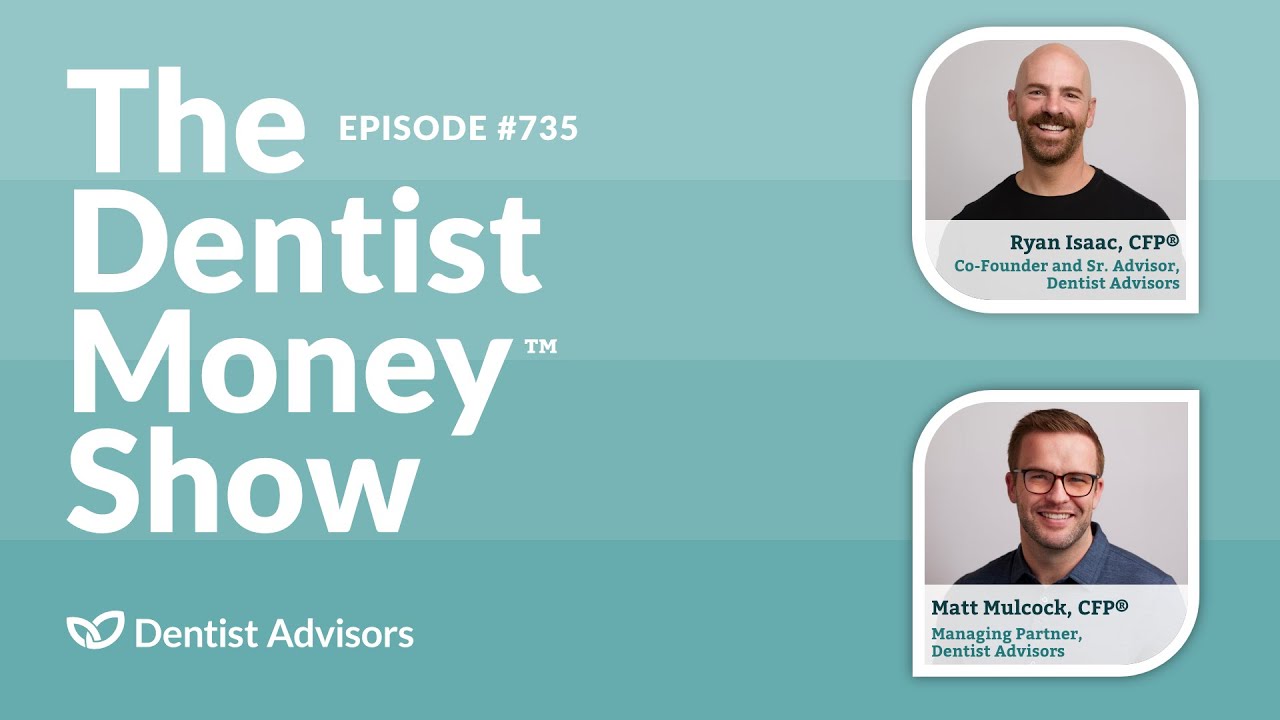
On this listener Q&R (Question and Response) episode of the Dentist Money Show, Matt and Ryan answer questions that are impacting dentists today, including how direct indexing works, who it’s best suited for, and why managing cash reserves has become more nuanced in today’s market. They also discuss whether the traditional 4% retirement rule still holds up and explore how personal spending habits shape long-term financial success. Tune in to understand how building a financial plan that balances retirement security and using your money intentionally can create meaningful experiences along the way.
Related Readings
What Was The Best Investment in 2025?
Podcast Transcript
Ryan : Welcome to the Dentist Money Show where we help dentists make smart financial decisions. am here, my name is Ryan by the way, it’s nice to be with you and I’m here with Matt Mulcock What’s happening Matt? Matt Mulcock.
Matt Mulcock : Here we are in a new year. No nicknames. New year, new us. Yeah, I think so. ⁓ Ryan, really, really quick. Can I show you the the perfect I just yes, matter what, I’m going to show you and the good people on YouTube ⁓ my kids favorite Christmas present they received this year, this past Christmas.
Ryan : New Year knew us? New year, new us. ⁓ We can do nicknames. Yeah. Yes, I don’t even know the question, but yes. Yeah, I don’t care. Yeah, let’s go. Okay. Out of all the planning, spending, everything. Yeah.
Matt Mulcock : Out of all of the things, their favorite present, I’m to just show you here. Classic. Whoopi cushion. Should give a little, here we go. Ready?
Ryan : Let’s hear it. Give it a little squeeze. For sure. Yeah, let’s go. Yeah.
Matt Mulcock : It was that good. You want it again?
Ryan : Yeah.
Matt Mulcock : I’m sure this will get cut, but yeah, it’s dude. My kids love it. They love it. My kids will sit it like on a chair, like the coffee table and I’ll be like, dad, dad, come on over and have a seat. And like, obviously I can see what’s there and they just love it. Love it. So.
Ryan : Why is that the funniest thing I’ve heard? That still kills. A classic whoopee cushion, man. Hold on, hold on. I gotta do this now. This is probably ⁓ another episode. When was the Whoopi cushion invented? ⁓ Let’s see, this thing is just a classic going back to, ⁓ I mean, it’s been a good, just one of the best things ever, 1930. It created by JEM Rubber Company ⁓ in Toronto. Originally experimenting with rubber air bladders.
Matt Mulcock : Whoa. Amazing.
Ryan : Accidentally made a flatulent sound. realized they had comedy going. Uh-huh. They initially tried to sell it to Samuel Adams, the novelty company, not the beer, but they thought it was too crude. Another company picked it up and said, wow, it’s 1930.
Matt Mulcock : I was going say it had to be an accident. Yeah. That’s amazing. Well, even better, this is the self inflating. So you know, like the old school ones, you had to like blow them back up. This just self inflates. So.
Ryan : You had to blow it up. I’m so happy we started with this. Do you think it would be fine by our marketing editing team if before every question today, okay, by the way, today’s Q and R question and response. It’s not Q and A because we don’t necessarily think these are all answers. These are just responses. ⁓ Matt, where do people submit questions again on our website, dentistadvisors.com/podcast There’s a button.
Matt Mulcock : No, we just have words to say. Yeah, dentistadvisors.com/podcast I’m pretty sure, let me just double check that. I’m pretty sure we are working on getting just an email going, but we’ve actually had quite a few questions coming in.
Ryan : submission thing. Yeah, it kicks us. Yes, I was gonna say go there. A couple of our questions today come from there and then a couple come from podcast. Okay. And then a couple come from the dentist advisors discussion group on Facebook. So post there. Anyway, this is they come from. Oh, what would marketing say if before every question you did a whoopie? Question number one.
Matt Mulcock : Yeah, Dennisadvisors.com slash podcast. And then you can just sit back. Yep. Did you hear that? Hang on. Question number one.
Ryan : No, no. OK. Yeah.
Matt Mulcock : We’re the worst. Okay, let’s go.
Ryan : Question number one comes from, we’ll just do first names, ⁓ Periodontist, he says, ⁓ well, he says, I’ll just read this here, but the question, direct indexing and enhanced direct indexing is a smart financial decision and to whom would it apply? It’s more of a question, sound like it was a statement. So he’s saying, who is a good candidate? Who benefits from, who’s the right person for direct indexing and enhanced direct indexing?
Matt Mulcock : Yeah.
Ryan : Now, we’re going to have to assume what he’s meaning here by those two things. My assumption, and then you can tell me what yours is different. Direct indexing is when, OK, an index, S &P 500, first of all, that’s one of many, indexes. You can go buy an S &P 500 fund, mutual fund, ETF, like any kind. There’s more funds than even securities that exist. ⁓ that tracks the index, mimics the index in all flavors of that. You can buy one fund that does that. Or direct indexing is you literally go buy every security, all 500 securities inside and then you manage the trading and rebalancing of all those securities, adding companies, getting rid of companies. That’s direct indexing. then enhance from what I hear this as, and I research it too to make sure this is, but enhance would be like, the same thing, direct indexing, except you’re adding like factor tilts, small, you’re adding emphasis to small cap or, yeah, or leverage, yeah.
Matt Mulcock : or leverage, you’re like doing like leveraging up with either like options or some some other form where you’re you’re leveraging up on it.
Ryan : Okay. So is that the best way to define it? Direct indexing, enhanced direct indexing, very complex. Okay.
Matt Mulcock : Yeah, there’s, there’s also companies that do this. We, I mean, we have these capabilities. We don’t often do this, but when you get to a certain level of like a level of assets in your amount of money in your account, you can do what’s called an SMA. So it’s separately managed to count this. This is where a lot of firms will do this, where you can still, like, again, we have this capability.
Ryan : Mm-hmm. Mm-hmm. Mm-hmm. Mm-hmm.
Matt Mulcock : to do this as opposed to invest in ETFs or the mutual funds. We, and it doesn’t necessarily mean you own, always own every single stock in the index, but just enough to represent the index basically. So yeah. Yeah. You have seven companies, you own 40 % of the index anyway. There you go. You direct indexed it. Yeah.
Ryan : Mm-hmm. Yeah. Uh-huh. Which these days it’s like seven companies is like 80 % of the index. Yeah. The UDirect index. Well done. All right. So what say you, Matt? mean, the question’s like, who’s this good for? Does this apply to anyone? Is it helpful to anyone? How would you answer that? What would you say? Have you ever seen this before? Have you ever seen like a dentist actually do this themselves, direct index?
Matt Mulcock : Yeah, I wish we had Robbie here. Um, I know I have not seen a dentist, um, in my, in another life when I was at fidelity, this was a bit more common. Uh, we saw on the dark side. Yep. I was not a Jedi. I not, I had not crossed over. Um, by the way, Taylor asked me earlier, we did another podcast and he’s like, you watching the Mandalorian and like the new Mandalorian? And I was like, I don’t even know what that is. Yeah.
Ryan : Yeah, I haven’t either. Is that when you were on the dark side? You weren’t a Jedi yet? You were a Sith Lord? Okay. ⁓ I’m so excited. Yeah.
Matt Mulcock : Should I get into this? I need to get into this? Was that on Disney?
Ryan : Yeah. So the Mandalorian was a maybe a two. Yeah. It was Disney. It was a spinoff ⁓ from Mandalorian. You know what a Mandalorian is, of course. ⁓ insert whoopee cushion sounds at any point while I’m talking about this, but yeah. So it was a series on Disney plus, but I think it’s a movie now. It was one of their better spinoff series for, for sure. They have mini Grogu, which is a mini Yoda.
Matt Mulcock : No. I’d heard about it. Yeah. Hey. Got it. Okay. Worth it? Worth it? Okay.
Ryan : It’s awesome. of one of their best spin-off series forced to a million percent. Yeah. Yeah, and it’s a movie that just came out, Okay. All right. Well that has nothing to do with direct indexing. But yeah Yeah, I said you’re on the dark side. It’s uh, yeah
Matt Mulcock : Yeah, apparently. they’re doing another one. I’m either way. Sorry. Did I read that grass? ⁓ we go on side quests a lot. Yeah. ⁓ so yeah, I wish we had Robbie here. Cause I think he could get into the real intricacies of this. ⁓ but again, in another life, when I was at fidelity, this, this came up a lot more. ⁓ this was a thing with some, with a lot of our clients of like, again, using SMAs, they were still managed by us, like still professionally managed.
Ryan : Mm-hmm. Mm-hmm.
Matt Mulcock : ⁓ the number one thing that comes to mind for me of why people even are drawn to this is tax efficiency. That’s usually, I think what people are shooting for now. There’s an argument to be made that theoretically it is more tax efficient because it allows you to do things like tax sauce harvesting, individual holdings. ⁓ the other reason I think this works well is.
Ryan : just going to say tax efficiency. Mm-hmm. individual things. Yeah, uh-huh. Yeah.
Matt Mulcock : you can customize a little bit more around. So like we’ve had this just last year, we brought on some pretty large accounts, like clients who had pretty large accounts with existing positions. So, you know, we’re talking like multi seven figure brokerage accounts that have like a good portion in like a couple of different stocks. Well, we don’t want to just sell out of them. They’ve got massive gains. You can often
Ryan : Mm-hmm. Mm-hmm. Yeah, uh-huh. Yeah. Mm-hmm.
Matt Mulcock : build around them with like a direct indexing strategy. Yeah, that’s common.
Ryan : around them. Yeah, that’s pretty common. Building around, yeah, when clients come over from other, where they have accounts in other places, building around their existing positions because selling would not be a good tax move or a good portfolio move at that time. Yeah.
Matt Mulcock : Yep. Yep. Totally. And last thing I’d say, probably third reason is if somebody wants to just customize more. So maybe they want to, ⁓ this is why we don’t see it a lot with Dentist because where you would see it maybe more would be, let’s say you worked for a large Fortune 500 company and you had like a lot of stock that wasn’t even in your portfolio, but like you were getting stock from that company and you wanted to like exclude that from your normal investments.
Ryan : Mm-hmm. Yeah. Mm-hmm. Yeah.
Matt Mulcock : You can do that, or you want to exclude a certain sector just because of like, I don’t know, moral, you have like a moral leaning or something. ⁓ you can do that more with direct indexing than you can just like buying an ETF.
Ryan : Yeah. Yeah. Okay? Mm-hmm. Now the trade-offs, of course, if you’re going to have someone do it for you, cost, it costs more to have someone manage a direct index portfolio. There’s just more hours and work spent. And if you do it yourself, it’s an enormous time cost and assuming you do it correctly and well, and you don’t deviate and stray. I mean, here’s the thing, thinking about this, you know, let’s say you’re tracking all these positions, even if you don’t have all 500, but you’ve got enough to, to mimic an index and your favorite one, your favorite one.
Matt Mulcock : Sure. Yeah.
Ryan : you’re tied to it in some kind of emotional way. Maybe it’s been writing, you like the numbers behind it, but it’s being downgraded or removed or something in the index itself. I think about this, like, I think most people would probably start justifying why they’re not gonna follow the index anymore. I don’t know, S &P’s thinking this, but I kinda like it for this other reason. I don’t think it would take very long if you’re doing it yourself before you’ve drifted from
Matt Mulcock : Yeah. Yep.
Ryan : Mimicking an index and then just doing your own trading human nature
Matt Mulcock : Yeah, I would dare. I would dare say that anyone, even a dent, any dentist listening that even maybe this is the first time they’ve ever heard this concept and like, I want to, I’m like an interested in this. Even, even in that case, you would not do this on your own. Like you would, you should not do this on your own. Like you, you could come to us, right? You could go to an advisor, an investment manager and say, want to direct index for these various reasons. But
Ryan : Yeah, yeah, yeah. No, no, yes. It’d be so time consuming, yeah. Mm-hmm.
Matt Mulcock : they would be the one. I’ll say this. They should be the one to manage that for you. Like there’s no, there’s just no way.
Ryan : Yeah. Yeah. Mm-hmm. Yep. Yeah. There’s no way. It would be so time consuming. Okay.
Matt Mulcock : Yeah, and to your point, you would lose the plot so quickly. like it would be it would be like the equivalent of us on this podcast every day. You’re just losing the plot. You know what I mean? Just like, you know, just all the time.
Ryan : Yeah, he would. Just within 10 minutes.
Matt Mulcock : Just saying.
Ryan : So happy, this is the last thing I’m doing today and I’m so happy. This is how my day’s, my work week is ending. It’s so good. Yeah, it’s starting off with this. All right, question number two coming up, Matt. Number two. Yeah, yeah, number two.
Matt Mulcock : Your weekend is starting. Yeah. Yeah. Hit me. sorry.
Ryan : Question number two, this comes from Graham. It’s gonna be hilarious, sorry. ⁓ Retired dentist, ⁓ he says he was a 1980 grad, okay, retired dentist. I’m gonna read this, Watched podcasts for many years, talking about the opening of 20 plus new dental schools. This could have an enormous negative impact on the practice of dentistry.
Matt Mulcock : The editing on this podcast is going to be rough. Sorry, Michelle.
Ryan : beyond any other factors like staffing, insurance, DSOs, overhead. I watched approximately eight excellent dental schools close for lack of applicants. What could we be thinking? I think he’s saying, I’m watching dental media, podcasts.
Matt Mulcock : Well, I think we mentioned this on one of the two cents end of the end of the year. Uh huh. Yep. Yep.
Ryan : and you talked about it? ⁓ okay. So you want to recap really fast and since you already talked about that, sounds like he’s just asking about like why would this would be? What are we thinking? So maybe recap that real fast. Yeah. Yeah, I know. Yeah. Yeah. Yeah. I brought questions. You brought a whoopee cushion. That’s all that’s needed.
Matt Mulcock : Yeah, I don’t, I don’t have the numbers in front of me because I didn’t know the questions we were going to be going over. Um, I just bring up, we’ll be cushioned. Um, so, uh, if I remember correctly, I was reviewing the, the report from the health policy Institute and the ADA, and they were talking about, um, the growth of dentistry and how it’s still, you know, they were just, we were just reviewing all the numbers on two cents. And yeah, I believe.
Ryan : Mm. Mm. Okay. Yeah.
Matt Mulcock : some of the data shows that there was 20 new schools that are, think, opening this year or that were open last year. I don’t remember, but I think it was opening this year in 2026. So, yeah, and I can try to find it quickly. ⁓
Ryan : Hmm. Yeah, yeah. Okay, yeah. After after some were closing, apparently was that in the podcast? Yeah. Yeah. If you want to. Yeah, so as a retired dentist, just that, okay, responding to that feedback. So first of all, thanks, Graham. Thanks for listening to two cents and then sending in a question. It’s kind of cool. ⁓
Matt Mulcock : Yeah, it’s going to take me probably too long to find it.
Ryan : That’s okay. Yeah. I mean, he’s just probably asking like, what are we, what are we doing? Why, why would eight schools close in 20 new open? I have no idea what the answer would be. This is why we call it Q and R. So my response is like, I have no idea. I assume it just probably has to do with demographics and applicant numbers and you know, where people are trying to go to school. Um, which might have, might have something to do with like, why people, why do people decide to go to school? Where they go to school? Is it the school itself? Is it the geography, the location? Is it the cost? you know, especially with dental school costs being so high and still rising. I don’t know why everyone’s going where they’re going to school. But I would just assume it’s a demographic and applicant number thing. ⁓ You know.
Matt Mulcock : Yeah. Yeah, I’m trying to find the numbers. ⁓
Ryan : That is interesting though, more schools. I wonder if that would actually help in terms of competition for cost of dental school.
Matt Mulcock : Yeah.
Ryan : I wonder if that is part of reasoning behind like more options for people. Not that I don’t know, I have no idea if they’d be any cheaper. But that would make sense if there’s just more competition for dental school. Kind of interesting though.
Matt Mulcock : Yeah, and to your point, mean, why at school closes, it doesn’t necessarily like I think he’s alluding to. they close because of lack of applications? But I’m like, is that true or did they close for other reasons? So, yeah, no idea. And I can’t again, I can’t find. So I just I just used our little assistant called Google. ⁓ here’s what it was. So.
Ryan : Yeah. Yeah, Yeah, no idea. Yeah. Yeah.
Matt Mulcock : So not in a year. According to the ADA, is since, so this is since 2001. There have been 21 new dental school openings in the US. So not in a year.
Ryan : Okay, last couple decades. okay. Okay. Some have closed, some have opened over time. That makes sense.
Matt Mulcock : Yeah, two new new dental schools were opened in 2025. So, yeah, I think that’s reasonable. think 20 doesn’t sound right in a year. That’s too many. So to to last year, 20 about 21 in the last 24 years. Yeah, so that makes sense. You know what we do need? You know, we do need more hygiene schools. It’s or more like
Ryan : Okay, that seems reasonable. Yeah, that seems crazy. Yeah. Yeah, less than one per year on average. That kind of tracks. All right, well, good question anyway. He just disappeared. Yeah, I know. I know. Yeah. Still hasn’t even changed since 2020. Popping on over to the question you answered actually, Matt. So you’ll be familiar with this one. Popping over to the dentist advisors discussion group on Facebook for question number three. All right. Question number three. Benjamin asks, Benjamin’s actually a pretty common poster. Benjamin, thank you. Frequent. ⁓
Matt Mulcock : something, we gotta even that out a little bit. Yeah. Benjamin is a regular poster. He’s ⁓ what what are the kids call and like the like when they do live streams like they call like a super chat or something. I’ve never done it. I don’t know. Yeah, something like that. Or just you get like status when you’re I don’t know whatever it is. He’d be the top of it. He’s a super chatter.
Ryan : ⁓ on, on YouTube, super chats. Yeah. You can pay to have your chat highlighted like to the top of a live stream. Yeah. Yeah. He’s a super chatter. Benjamin. Thanks for being a super chatter. He asked in our discussion group, and this is after this is between the Christmas new year’s break. So this guy’s like on, on he’s going while the rest of us are off, you know, he’s thinking.
Matt Mulcock : I was relaxing drinking eggnog up, I was typing back to him. I don’t even know what I said. Hopefully it was good.
Ryan : Well, let’s see if your answers match here. Every time they don’t match, I’ll make a farting noise, except I don’t have a whoopee cushion. All right. He has, what’s your opinion on keeping your cash equivalent reserves in short-term government bonds like SGOV versus something like a high yield savings account at some place like Capital One? you got cash equivalent, just cash on hand. might be like business reserves, something. Do you do short-term government bonds or ⁓ high yield kind of savings?
Matt Mulcock : Hey. Okay, deal, deal.
Ryan : And he said, aside from losing FDIC insurance on the first 250, meaning if it’s in bonds, are there any major downsides to getting cash from bonds, short-term bonds, if you needed it for an emergency? So, you know, short-term government bonds versus high yield savings accounts for cash equivalents, extra business cash, maybe even personal emergency funds. Yeah, I have your written answer here in front of me. Yeah.
Matt Mulcock : Yeah. You have my written answer so you can check. ⁓ Now I remember I was actually in my hotel in Mexico. I was traveling over the break.
Ryan : Isn’t that funny when you can recall conversations of where you were when they happen, even if they’re very like, you know, it’s not some like life changing conversation.
Matt Mulcock : Yeah. I was, I was, I was like in my hotel room, ⁓ on the edge of the bed. Like I was like on my knees, but like using the bed is kind of my desk. I was like typing it. Yeah. Yeah. Yeah. I was kneeling on the floor using the bed. It is weird. Yeah. And then I, well, then I get up and I’m like, ⁓ my back. Like, yeah, no matter what. Yeah. Yeah. No matter what I do, I’ve got back problems, but, ⁓ yeah. So.
Ryan : Yeah, I do that all the time, like kneel on the floor and type on the bed. It’s so weird. I do that. What an old guy. It’s probably like back problems. That’s what I’m saying. Yeah. But it’s better than like laying on the bed typing on your lap. Everything hurts. Yeah. That’s true.
Matt Mulcock : I don’t remember exactly what I said, but I will, can cover, I think.
Ryan : Yeah, the difference between those two things, maybe the pros and cons of the two risks you might run of the two things.
Matt Mulcock : Yeah. So from our perspective, using a high-yield savings account is gonna be better. It’s gonna be the best way to short-term cash. One of the issues with using short, so I’ll just say this, when you use a high-yield savings account, it’s as liquid as it can get, right? That cash is just in an account and your name, as he pointed out, FDIC insured up to 250.
Ryan : Mm-hmm. Mm-hmm. Mm-hmm.
Matt Mulcock : And really even more if it’s like you and a spouse, because it’s 250 per social. So it’s like 500. ⁓ so you get that coverage and it’s as liquid as anything you can, you can have. and here’s the, just accessible as quickly, like no penalties, no issues. Whereas with, if you’re using, if you’re going direct, right. So banks are using short-term.
Ryan : Yeah. ⁓ How would you define liquid just for people listening might not catch that. Okay. No penalties, no fee. Yeah. Yeah. Yeah. Mm hmm. Yeah. To offset their cash lending. Yeah, their cash. Yeah. Yeah.
Matt Mulcock : instruments like government bonds to offset their. exactly. So they’re, they’re using it. So I guess we’ll hit the benefit of that. Whenever you have an intermediary, whenever you have someone in between you and your yield lay in this case, the bank, your yield is going to be lower. Like they’re going to take a fee. And in this case, the fee is a smaller yield. The difference is they’re taking it. So if you’re using a short-term government bond, you will most likely get a little bit of a higher yield.
Ryan : Mm-hmm. Mm-hmm. Mm-hmm. Yeah. Mm-hmm.
Matt Mulcock : which is a good thing. there’s a reason to do that. Here’s the kicker or the trade-off you’re making. If rates move, right? So if rates go up ⁓ or if there’s any movement whatsoever, when you’re the holder of the bond directly, you are subject to that movement, up or down. if, because your principles. So there is a chance when you’re investing in short-term bonds directly,
Ryan : Mm-hmm. Yeah. Mm-hmm. Mm-hmm. Which is your principle. Yep.
Matt Mulcock : that it’s not just the yield that you’re receiving, but your actual principal amount can go down. So it can go up. It’s just like any other investment. But if you’re talking about risk and their use of like an emergency fund and what that money is supposed to do for you in your life, the best way to you or the best vehicle to use in our mind is a high-oil savings account. Like give up a little bit yield to make sure you’re not going to lose principal.
Ryan : Mm-hmm. Yeah. Yeah. Yeah. Yeah, cash equivalent. Yeah. Yeah. And if you think about like the typical, the typical use of money for this, this might be like excess business savings. might be like your tax payment that’s not due for eight more months. In reality, the amount of time that you would actually keep it invested and the difference between a high yield savings and then short-term government bonds. mean, it feels
Matt Mulcock : So minimal.
Ryan : Not only the spread there is probably pretty small, but really everything’s time with investing. So even if it was a higher rate, such a short period of time, it’s just not likely that it’ll make enough of a difference for you to want to even carry any kind of risk at all. Short-term money you know needs to be immediate accessible emergency funds, or you’re literally going to use it in three months, six months, even 12 months because it’s your tax payment.
Matt Mulcock : Yep.
Ryan : I just don’t think it’s worth putting it in anything that could lose value.
Matt Mulcock : Yep. The other thing here too, I think if I remember correctly, he referenced a specific ETF. He gave like a ticker. Yeah. So that’s an ETF that invests directly in short-term government bonds. Oh, yeah. So the other part of this, I’m glad I didn’t forget this since it was like, you know, a couple of weeks ago. The other part of this though is again, we talk about liquidity and access to your funds.
Ryan : Yeah, he did. He S G O V. hmm. It’s what you said. It’s part of your answer where you’re going next. ⁓ Yeah ⁓
Matt Mulcock : Although still liquid, if you invest in like S-gov in like a brokerage account, there’s still settlement times. So it’s still going to be more delayed than just holding it in a high yield savings account. Yep. Can’t can’t get it. Yep.
Ryan : Mm-hmm. Yeah. Yeah. So clients, I need the money today. Can’t today. Yeah, it’s gonna be at least probably two business days. Yeah, you did say that. And then he followed up. said, yeah, thanks. This sounds good. It seems like the best option that makes sense. said, so maybe something like S-gov might be better for a medium to long-term savings for like a large purchase. It’s gonna be a down payment for something. It’s gonna be a car down payment, a car equipment. It’s a few years away, but it’s also money you know for sure you’re gonna have to spend and use.
Matt Mulcock : Sure, it’s a few years away. Yeah, I’d love that. It’s not emergency fund money and it’s project money. That’s like two years away or something. Yeah, great. I didn’t even see that he responded. I should pop in there.
Ryan : Yeah, I agree. Yeah. Yeah, I agree. I give it a like, which will matter a lot.
Matt Mulcock : For sure. I don’t even need to answer now.
Ryan : This, uh, this fourth question, question four, I just checked the time and I was like, there’s no way you and I just got through three questions in 24 minutes.
Matt Mulcock : Can we get this is this number four? We’re flying. Here we go. Number four. That was the best one. That was by far the best one. I’ve. we’re done. We’re done. Yeah, we’re in trouble. We’re in trouble.
Ryan : We’re gonna get so killed for this. This is like a new high or low, know, years ago, many, many years ago, some people remember this. Reese had a chime. Do you remember this? It was like on a block. And, after like a dirt between segments of the podcast, we used to have like commercial segments. We’d he would hit the three. was a three note chimes like GAC. I have no idea what the notes were, but we would finish a segment hit and true to form. Reese would be like, Hmm, this calls for like, ⁓ this calls for a G major.
Matt Mulcock : Do the chime. Yeah. Yeah. And we have now regressed. Yeah, we’ve regressed. Yeah.
Ryan : We’ve already crossed 2026. This calls for a short one, WhoopiCushion. All we have are the options of short and long, right? Okay. Your WhoopiCushion doesn’t have more options. There’s no pitch on that. Or power. Do have like a power setting? Okay. It’s not. Okay. This is a, man, this is a good question. I think is its own podcast.
Matt Mulcock : Yeah, that’s it. Yep, pretty much. I don’t even know if this is usable at this point. I don’t think it’s usable at this point.
Ryan : Who dove into the comments here? We had a few, Taylor was in the comments, Taylor was in the comments, a couple clients in there. Okay, here’s the question. It starts off by saying, and this comes from Donald, shout out Donald, thanks, Dentist Advisors Discussion Group. Join it if you’re not in there, go join it and post a question. This is good stuff. He says, starts with, on the topic of 30 total term and the 4 % rule, we know where this is going.
Matt Mulcock : Join it and post your questions. Yes.
Ryan : He says the 4 % rule of thumb was based on having a very safe margin to get through the worst possible downturns in a 30 year period based on the Trinity study in 1998. Okay, that seems factual.
Matt Mulcock : think it was 94, but yeah.
Ryan : Benjen, that’s the guy’s name, Benjen, his newest updates says that 5.25 to 5.5 % is probably more true with a better portfolio allocation and more historical data to use now. We did a podcast episode on this a couple of years ago, actually, on the updated 4 % rule, which this would be really cool to revisit because we have been discussing this as a team a lot.
Matt Mulcock : Will will been Benjen here. I think so, yeah. Yep.
Ryan : He says, in the recent podcast you guys mentioned changing the 30 total term, are you guys feeling like it may be too conservative, especially with a globally diversified portfolio and proper planning? He says, I feel like chasing a 95 % success rate with success based on not running out of money in 30 years is far too conservative number to chase when the average lifespan is only 78 years. There’s a much greater chance of dying well before that 30 years than running out of money. Probably true. He continues, shooting for too high could be too. Shooting for too high to be conservative also leads to one more year syndrome where we keep working to build bigger and bigger safety net for mental peace of mind at the cost of more years. He says, I understand recency bias, sequence of returns, et cetera, but wanted to know your thoughts. Basically saying, 4 % rule is a little outdated, new data, including the guy who came up with it, Benjen, says it’s closer to five and a quarter to 5.5. Your total term, Dentist Advisors, was based on less than a 4 % rule. It was actually based on 3.3.
Matt Mulcock : 3.3.
Ryan : to accommodate for a couple of things and account for a couple of things. ⁓ What do you guys think about that now? Is that too conservative? Should we not be shooting for something so high? Again, this is its own podcast, for sure. This is its own podcast, Rethinking the 30 Total Term. I love that idea. ⁓ But take it away from here. What are your initial thoughts on this?
Matt Mulcock : Yeah. Yeah, you’re totally right. This is a whole, whole other podcast. Uh, but we’ve also talked a lot about this and I’ll say this, the short answer is I, I agree with him. I agree with Donald. Uh, my thinking on this has evolved quite a bit. Um, I’ll, I’ll also say, this is really difficult to like thread the needle of general advice on a podcast when
Ryan : For sure, yeah.
Matt Mulcock : of all of the things around this topic. This is the mother load of it depends. Right. This is like it’s so specific to the person. And the first thing that I think of when it comes to this is personality is such a factor here because well what you value and are you already a super saver? Like are you already so
Ryan : Yeah, uh-huh. Completely. Mm-hmm. Mm-hmm. Yeah. What you value. Mm-hmm.
Matt Mulcock : Sometimes I Okay, let’s so we are we gonna go down a side quest. I think this is gonna be helpful I think this is gonna be a helpful side quest
Ryan : Yeah, no, let’s go. Let’s go. Yeah, and then we’ll just use this prep for the long podcast we’ll do on this.
Matt Mulcock : Okay. So I heard this concept last year on a podcast, one of my favorite ones, modern wisdom. And he talked about this idea of, ⁓ advice. How did he, how did he phrase it? ⁓ advice, hyper responders, kind of this theory of like hyper response to advice. And what he talked about was, and I love this concept. I think it applies so much to what we, what we do is that, the asymmetry of like,
Ryan : Mm.
Matt Mulcock : advice and how you how people accept it. so for let’s just go down this for this example. We talk about saving how much you need to be saving and like setting guidelines like 30 and 20 percent savings written all this stuff. The people who are going to listen to that advice are the hyper responders. They’re the people that are already thinking I need to save more. I need to do more like they’re the people.
Ryan : Mm-hmm. Mm-hmm. Yep. Yeah. Yeah. Okay, yep. I need to do this. That’s why they resonate with it and they do it. Okay, yeah.
Matt Mulcock : And they do, and they probably go over the top where it’s, it’s almost like this paradox where it almost like the people who probably need to relax a little bit are the ones who are going to respond to it. And the people who are not going to save anyway, aren’t listening. They’re just like, whatever. Like I’ll save tomorrow. I’ll save later. It’s kind of an interesting concept. So when we talk about 30 total term, I think for the people who are going to listen to us.
Ryan : Yeah. Mm-hmm. Yeah. Uh-huh. Yeah, that’s a point. Yeah. Uh-huh. Mm-hmm.
Matt Mulcock : the hyper responders, it’s way too conservative for the people who need to hear it. I’m like, no, you probably should try to shoot for a 30 because you’re not going to hit it, but you might as well set that bar a little bit farther. It is conservative, but you’re going to get your, if it gets you two thirds of the way, you’re going to be okay. So I hope that all makes sense. I, there’s, it’s just, if we’re just saying, generally speaking, what per like, where should you be shooting? think 30 is too, too conservative of a goal.
Ryan : Mm-hmm. Mm. We need, yeah, yeah, no, yeah, uh-huh. Yes. Yeah. Yeah. That makes sense. Yeah, yeah it is. Like you said, it depends so much. I’ll give you an example from a call I was just on this afternoon. It’s a client ⁓ mid-career doing well ahead of the average dental curve ⁓ on par with what our clients typically do. But ⁓ his savings rate is 10%. Yet, because of the size of his net worth and the dollar amounts, his 10 % is a high dollar amount though, because the income’s really high. So those dollars compounded projected out combined with his existing net worth and the other growth of his other assets are going to be adequate. And it’s highly likely he’s in his forties by the time he’s in his fifties, if he’s not done already, it’s highly likely he technically won’t even need to save any money. The momentum alone will continue to carry. And this will be the case for quite a few people where technically, you don’t have to go spend money just because you don’t need to save anymore. just, whatever. But it will be the case where some people don’t even have to save anymore. The momentum they’ve built in the first half of their career will carry them. So like you said, it’s a very, very, it depends kind of question because just one flat number, 30 total term, 20 % savings rate, that’s not enough to tell a whole story. Also, are you retiring at 65 or 45? If it’s 45, you better hit a 30 total term. You just have to.
Matt Mulcock : Huge. Yeah. By the way, it’s now, it’s now no longer TT. It’s now RR.
Ryan : RR, retirement readiness. Yep. ⁓ It would teach the audience a new language.
Matt Mulcock : Well, the thing is that that’s kind what we’re shooting for is we’re moving towards clarity as opposed to cleverness where it’s like retirement readiness is self-explanatory. So.
Ryan : Retirement readiness. Perfect. Yep. And you’ll be seeing more of this in our, some of our content and our website, if not already, right? Some of these just the new ways of talking about it. But ⁓ yeah, it’s like, what age are you trying to be ready for retirement and be done? If it’s your forties, it better be close to a 30 score. If it’s your sixties, you know, we’re starting. Okay. That’s, yeah, that’s one thing. Here’s another.
Matt Mulcock : Yep. Yep.
Ryan : Truth though, if you look at the ADA’s data, dentists are not financially prepared even up to 70 years old. They’re not ready to retire just based on the ADA’s own data. So we know, and there’s reasons why probably many dentists continue to work later in life that aren’t just financially related, but we know that money’s a problem. A lot of people would stop working if they could in dentistry. So we know that like the average dentist is not hitting even what we would call a 15 or a 20 retirement readiness or TT for the old schoolers. It’s not like everyone’s hitting a 20 or 25 and they’re like, I don’t need to push to 30. They’re underprepared. So to your point, what I still like about even a conservative goal is even if we don’t need to hit it or we don’t hit it, all it means is you’re just gonna be. that retirement readiness will just hit at a younger age in your life. That’s all it means. And if along the way you haven’t sacrificed a good life, you get to spend, you get to travel, you get to live where you want, which most dentists can, it’s all timing. If you haven’t sacrificed living a life along the way, then I like that people have pushed themselves because statistically the facts are dentists spend more money than the average person by quite a lot. And which means you just have to have more money later. ⁓
Matt Mulcock : quite a bit.
Ryan : to be able to spend like that. But back to this point, back to this point, I should read Taylor’s comments actually. ⁓ Yeah, that’s a very conservative target. A 30 retirement readiness or TT score, a 4 % withdrawal, that is conservative and recent data would tell us that that’s true. So I’ll pause there. Well, what else would you have to say? I’m gonna look at Taylor’s comments here.
Matt Mulcock : Yeah. Yeah, I mean, I think everything you said is ⁓ spot on. And I just again, it’s just so personal to the and so dependent on the person, their personality, their timing, their goals. ⁓ If I again, generally speaking, I would I would. If someone said, OK, you you’ve got to select like a new either keep it at 30 or select a new kind of
Ryan : Yeah. Mm-hmm. Mm-hmm.
Matt Mulcock : baseline or new guideline, I would probably say 25 would be the ultimate kind of, if I’m just saying generally speaking, you should be shooting for a 25 outside of your home, by the way. So I think before, yeah. So the 30 total term, I think we always kind of assumed, or maybe just didn’t really point it out very much back in the day that more 30 included your home. I think in most cases.
Ryan : Mm-hmm. Yeah. Mm-hmm. Mm-hmm. Yeah. Yeah. That’s something Taylor brought up. was just going to add in there. Mm-hmm. Yeah.
Matt Mulcock : If we’re saying 25 outside your home, it’s probably a 30 with your home. So, ⁓ I think it’s still for a young, a younger, youngish dentists, let’s say in their late thirties, early forties, still mid career. Someone just is like, what am I shooting for? Yeah. Yeah. Yeah. 15 to 20 % savings. And I’d say about a 25 times your, your, your annual spending. It’s.
Ryan : It’s almost like a 30 with your home. It is. Yeah. Yeah. Mm-hmm. 20 % savings rate, 25 retirement readiness score. Mm-hmm. Annual spending and net worth, usable net worth. Yeah. Yeah. I think that’s a great guideline and it takes into account some of the new numbers, but also it takes into account the humanists of ⁓ an entire life and career and wealth building path, which has so many twists and turns and unexpected things. And, you know, for people who are spending a lot of money, you got to just, you can’t expect that you won’t spend that much later.
Matt Mulcock : unusable net worth. Yeah.
Ryan : Once you’re used to that, even when you start to imagine, oh, mortgage payment will be gone or student loan, yeah, some payments will be gone, some kids will be out of the house, but you’re used to the life that, the $25,000, $30,000 a month, you’re used to what that life feels like. In little ways, the Amazon orders, the big ways, the house you live in, the stress that you feel or don’t feel, you’re used to that life. And so it’s just statistically highly likely you’ll continue living it. So, you gotta save more.
Matt Mulcock : Yeah. I think that you, mentioned, you just kind of alluded to it earlier too, like, don’t let this come at the cost of living a good life now. And I, know Donald and he’s amazing and, that personality that is like an optimizer. And so, which is great. I think that that works for him, which, which is why I think I brought up initially like personality matters here. Like very personal. again,
Ryan : No? Yeah. Yeah. Mm-hmm. Yeah, yeah, it’s very, very personal. ⁓
Matt Mulcock : the risk of getting too optimized and too locked into the numbers. We’ve seen this ⁓ even when you achieve whatever that number is 25, 30, whatever it is. Then the challenge begins of, OK, what do I do now? And how do I physically get myself to actually spend money that I’ve built up when I’ve been in this like super saver mindset? So again, this is why this is a whole other podcast.
Ryan : Yeah, uh-huh. It’s hard either way, Yeah, Donald’s comments back to Taylor was, did you just tell me to yellow my money? Yeah, it’s like, yeah. Yeah, that’s what we’re telling you exactly.
Matt Mulcock : To Yolo. Yeah. Well, we keep teasing this and we want to do it. We’re going to do it as a die with zero podcast book review. ⁓ cause that book has just gone bonkers.
Ryan : huh. Yeah. I was just gonna say, dude, do you feel like the idea, this is just my anecdotal experience of being an advisor. I feel like for a long time, there was a lot of like legacy, leave behind a lot of money, die with a lot to pass along, which still exists. It’s very personality driven. Things probably overrated, my opinion too. But also it feels like that’s changing. A lot of my clients as time goes on are asking more and more, even people who have the money to leave behind, they have enough.
Matt Mulcock : overrated.
Ryan : are starting to ask like, do I really like, how do I make this so I use most of it? You know, ⁓ it seems like that’s becoming more common. you, is that just, maybe that’s just my bias from recent conversations, but so like the world, it like society generational? Like what do you, yeah, what’s happening there?
Matt Mulcock : No, think you’re, no, I mean, it’s anecdotal for me too. I total shot in the dark. So first of all, say anecdotally, I feel the same thing. I’m hearing this a lot more. It feels like the tides have shifted more to this die with zero mentality, not that people truly want to die with zero. think there’s still a feeling of like, I want to leave them something, but I don’t know if it was like, I think my answer for all this stuff is always like things changed after COVID.
Ryan : Mm. Yeah. Mm-hmm. Mm-hmm. Yeah. Yeah, it’s true.
Matt Mulcock : It’s kind of like the Bitcoin fixes this equivalent of like COVID changed everything. ⁓ But I think it really did. I think a mindset shift across society on many levels happened during COVID. And I think this might have been one of them. And then obviously this book, I don’t know when it was published, but I can tell you that it’s made the rounds and it’s like, I don’t know if like the Mormon wives of
Ryan : Yeah. ⁓ Mm-hmm. Mm-hmm. I know. It got picked up somewhere on social media. Let’s see when it’s published.
Matt Mulcock : The Mormon secret lives of women or something all of sudden, whatever it is, the secret lives of Mormon. There you go. I don’t know if
Ryan : Oh yeah. Yeah, that’s not even close to the title, but yeah, you got it. I got the gist of it. Secret lives of one of my wives. You got it. got it. Wildfire.
Matt Mulcock : they like did a book club about it or something, whatever it is, it picked up steam. It’s everywhere.
Ryan : ⁓ here, let’s, yeah, I want to see what, I feel like this book came out. ⁓ Let’s see. Yeah, it wasn’t that recent. When was Dio Zero published? ⁓ 2020.
Matt Mulcock : Two years ago, I want to say. Yeah, there you go. There you go. There you go. It’s, it’s picked up some steam. I think one of the stats from that book that has resonated the most with me and I, and I’ve heard this reference by a lot of people, ⁓ to this, it goes along with this exact idea of like retirement readiness and cause the other part of this too, and we talk about a 25 or 30 total term or retirement readiness number. We are talking about assuming that you want to leave money to your kids.
Ryan : Okay, interesting July of 2020. Yeah. Mm-hmm.
Matt Mulcock : Because if you don’t, that number can be much lower. If you truly are wanting to go die with zero strategy, then you don’t have to be shooting for a 25 or 30. You could be shooting for most more likely like a high teens or 20. It’s going to increase your risk overall of like a bad market stretch or something. ⁓ But if that’s your goal, then. More power to you. So.
Ryan : Mm-hmm. No. yeah 18 to 20 17 to 20 yeah yeah Mm-hmm. Yeah. Mm-hmm. Yeah.
Matt Mulcock : And I think that’s starting to become maybe more of a thing for people. ⁓ but to this point of, of like, a leg, a financial legacy, I think the stat from that book that really resonated with, again, me and a lot of people was the average age of when you actually inherit money. And I don’t remember the exact age I’m going from, from memory, but I believe it was something like late fifties or like early sixties, like early sixties.
Ryan : Hmm. yes. huh. Yeah. Yeah, it’s older. Uh-huh. That’s almost near retirement age. Uh-huh. When you… Yeah.
Matt Mulcock : And he talked about this of like, think about, think about that for your kids. Like, do you think your kids at 55 or 60 are going to need that money or are they going to need it now when they’re in their twenties and thirties? Yeah. So if you’re going to be giving, if your goal is to leave a financial legacy, why don’t you enjoy it with them?
Ryan : Mm-hmm. Mm-hmm. Yeah, when will they need it appreciated the most? yeah. Start taking your young adult children who are still in college and struggling and building their careers and dreams and travel the world, help them with their first home, whatever it is, start a business, whatever it is. It could be a lot of things. It’s probably more meaningful to a younger person still building their life than a 60 year old, 65 year old.
Matt Mulcock : Sure. Yep. Yeah. I last thing on this too, I’d say is whenever this topic comes up, I always think like there’s so much, like, I don’t know why. mean, I do know why, but people always default to when they talk about leaving a legacy or this, this idea is like their number one value. It’s always monetary. And it’s like, there’s so many things. There’s so many things I would say when it comes to leaving a legacy, money’s bottom of the list of like what you should be thinking about.
Ryan : Mm-hmm. Yeah, that legacy is $4 million. Yeah. Yeah. huh. If I think like, what would I want my grandkids to like remember me for? ⁓ they’re probably like money, dude. Like, you know, I would, I would choose something differently. Yeah. I’ll be like, which one of my grandkids, you know, embrace the ocean and, and surfed. That’d be, that would be so cool for me, but they’re like, no, I would have taken money. What are you talking about? Surfing? I can surf when I’m rich too, you know?
Matt Mulcock : Yeah. They’re like a Maserati cramp. Yeah. Yeah. Yeah, exactly. Yeah. Well, and again, it could it can be money. But to me, it’s you’re either leaving money or you’re making memories and both cost money. So you’re leaving money regardless. But to me, it’s if you’re if money is the answer, if you’re like, want to leave money. Well, they’re either going to take that money because I think the end of the day, all money.
Ryan : probably easier. So yeah. Mm-hmm.
Matt Mulcock : The whole purpose of money is to get spent and the highest return on that experience is making memories. So if the goal is to spend money or have your kids take that money and spend it on something living a good life, do it with them. Make the memories with them. That’s the best investment you can make. Multiply that money.
Ryan : Mm-hmm. Yeah. Yeah, yeah, yeah, yeah. Have those memories. I completely agree. I completely agree. All right, well, it was something in that. Well, do you need to hit a note for the fifth one?
Matt Mulcock : We just added a fifth, I think, at the end there of our own. I don’t know. I feel like these are all going to get edited and we’re just going to get just right through the calls.
Ryan : This whole podcast will be us referencing these different noises that never happened. I think they should be left in here. It’s what the people want.
Matt Mulcock : So, exactly. I don’t think so. Do they? I don’t know. Should we hit one for good luck to close us out?
Ryan : Yeah.
Matt Mulcock : that was an airy one. Hang on.
Ryan : For my part, will say ⁓ dentistadvisors.com/podcast and ask them some questions there. Go to Dentist Advisors Discussion Group on Facebook, post some questions. If you wanna chat with us, talk about any of these things in your more personal, it depends kind of situation, then just book a free consultation. We’d love to have a talk with you about your life and your goals and what you’re trying to do and help point you in the right direction. Matt, anything else coming up this year we wanna talk about? Any other? ⁓
Matt Mulcock : yeah. Some big things, some big things happening. ⁓ The ⁓ third annual Dentist Money Summit If you like conversations like this minus the antics, ⁓ more elevated. Yeah. Literally elevation. we love this. This is our third year. We’re in a new place this year. This year it’s in Midway, Utah. For those of you that are like, where’s Midway
Ryan : happenings. Yeah, I feel like it. Mm-hmm. More elevated, not just due to elevation actually, being in Park City.
Matt Mulcock : Basically think Park City. Yeah, Park City, a little just a little bit further ⁓ up the canyon a beautiful area and Our goal with the with the Summit the Dentist Money Summit is to make it feel like a vacation But you still are there to get something of value bring your family get CE listen to Yeah, ⁓ and we’re gonna have so many activities
Ryan : Midway between, yeah. Yeah. Yeah. So pretty. ⁓ So much to do. It’s so pretty that time of year. Man, it’s just warm and yeah, so good.
Matt Mulcock : ⁓ The theme this year is, ⁓ Practice on Your Terms so you can get more information. can sign up at, ⁓ dentistmoneysummit.com ⁓ back by popular demand. No, not me. Dr. Daniel Crosby. I’m coming back, but, ⁓ Dr. Daniel Crosby is going to be there again. We had so many, he was in year one and so many people were like, you got to bring him back. it is.
Ryan : Mhm. Yeah. Like Matt from WCog. Yep. So excited. Yeah. That might even be a state of residence by the time our Summit rolls up. Yeah. Yeah.
Matt Mulcock : It is going to be by the time I talked to him the other day and ⁓ he will be back. He’ll be living in Utah by then, which is going to be amazing. It’s driving up exactly. So be awesome. dentistmoneysummit.com
Ryan : Yeah, all right, he’ll just drive up from his house. Okay, yeah, we’re stoked. Okay, well thanks very much for joining us, Matt. Thanks for adding the color commentary today and all the good stuff in between. Thanks everybody, catch you next time, bye bye.
Matt Mulcock : Of course.
Keywords: dentistry, financial decisions, direct indexing, dental schools, cash reserves, 4% rule, retirement planning, legacy, financial advice
Retirement Plans, Saving
