





I had several conversations this past week where people have told me they’ve really started to feel the impact of inflation. And yeah, that makes sense. If you’ve been to the grocery store, or filled up a tank of gas, or looked at your insurance renewal bill lately, the rising prices are hard to miss.
At the same time, in every one of those conversations, we also talked about how their family income had risen significantly this year. But for some reason, the increase in income was waved off with a dismissive “Oh yeah, that’s cool,” while the topic of inflation was met with a derisive, “Can you believe it!?”
Now, this is probably just human nature, but I feel like we’re misunderstanding the current economic environment when we curse at inflation without acknowledging that incomes have risen to counter the higher prices.
The following graph shows that median household income (ADJUSTED FOR INFLATION) hit a record $87,460 in 2025:

Taking a closer look at the graph, you can see that median household income was flat from 2000 to 2015. That’s 15 years with no progress after accounting for inflation.
There was a huge spike from 2015 to 2019, then flat from 2019 to 2024, and now we’re seeing another surge.
Overall, household incomes have grown 18% above and beyond inflation since 2015.
Now, if your determined pessimistic response to that data is, “Well, it’s all just the rich households making that number go up.”
First, you’re getting your math terms mixed up. The average household income would be brought up by the ultra-wealthy, but the median simply measures the middle household in America.
Second, the wealthy have not hogged all of the income gains to themselves.
In fact, on an inflation-adjusted basis, the poorest fifth of households has seen by far the biggest gains in income since 1990:

Income for the bottom 20% of households has grown over 100% since 1990, and I’ll keep repeating, that’s on top of inflation.
Here’s another graph from the same study:

Since 1967, the share of households with incomes of $150,000 or more has quintupled. If you were wondering, yes, that is adjusted for inflation.
Is most of that extra income likely due to more women in the workforce and more dual-income households? Probably. But regardless, households today have far more income to work with than previous generations.
Speaking of past generations, there seems to be a constant discussion about the shrinking middle class. And Pew Research shows that, indeed, the number of households making a middle-class income (between $61,000 and $183,000 annually) has shrunk from 61% in 1971 to 51% in 2023:
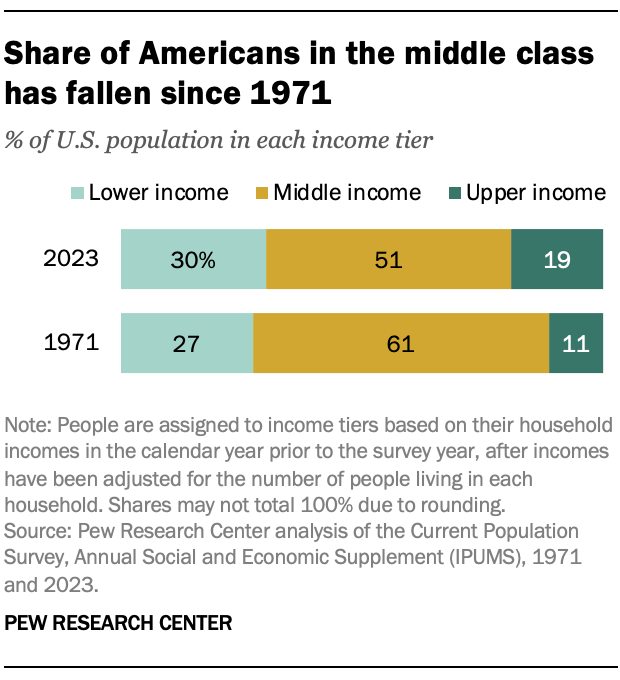
But what we fail to mention in that discussion is that more middle-class families moved up than down in the past 50 years. The upper-income households have grown at a faster rate than the lower-income households. That is a sign of overall economic progress.
So household income is at record highs. Most people leaving the middle class are moving up. Everyone feels good, right?
Unfortunately, I have one more chart to share. The blue line tracks the S&P 500, and the orange line is Michigan’s Consumer Sentiment Index, which is essentially a monthly poll of how Americans feel about their finances and the economy:

This century, those two lines moved together. When markets fell in 2001 and 2008, sentiment fell with them. Then markets recovered, and sentiment recovered. It all made sense. When the economy was good, people felt good.
But in the year 2020, those two lines went in drastically different directions. And they’ve been running in the opposite direction ever since.
Did COVID break our brains?
It seems like no matter how positive the economic news, people still find a way to be disappointed.
So in the end, maybe I’m just the Simpsons meme:

Thanks for reading!

Jake Elm, CFP® is a financial advisor at Dentist Advisors. Jake a graduate of Utah Valley University’s nationally ranked Personal Financial Planning program. As a financial advisor at Dentist Advisors, he provides dentists with fiduciary guidance related to investments, debt, savings, taxes, and insurance. Learn more about Jake.