





The stock market has taken a bit of a tumble recently.
Interestingly enough, almost exactly a year ago, the stock market experienced a similar decline due to the Trump Administration’s proposed tariffs. In early April of 2025, the S&P 500 dropped around 12% in one week.
This year, largely due to the consequences of the war with Iran, the S&P 500 dropped nearly 9% from late February to late March.
To give some context of what’s happening outside of the U.S., international developed and emerging markets also dropped 11% and 13%, respectively.
Here’s the S&P 500 movement since January 1st:
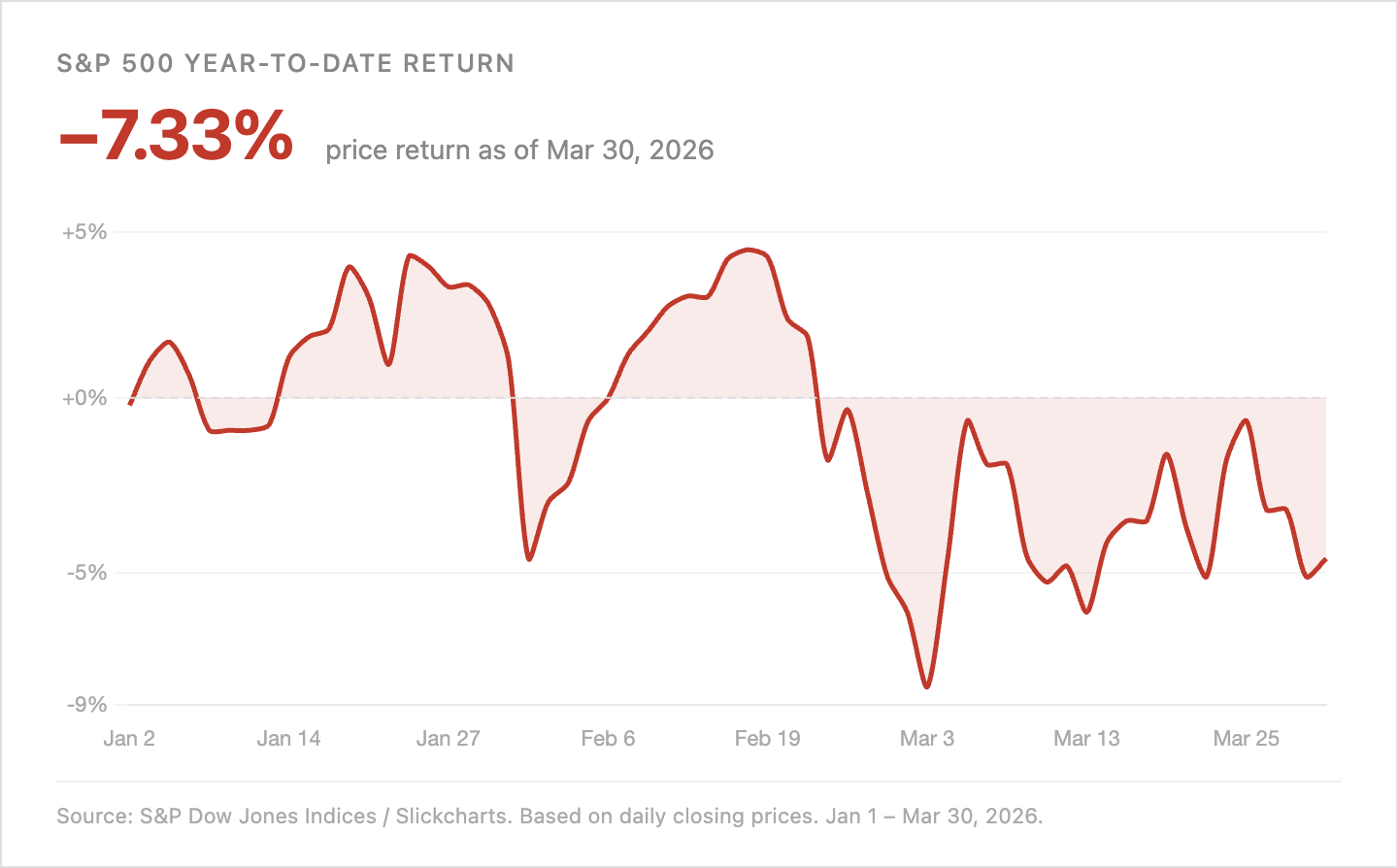
Yet, I haven’t heard nearly as much panic or complaining surrounding this decline as I did with the tariff-driven selloff last year. I’m not exactly sure why that is, but regardless of the reasons, it’s still never fun to watch your investment portfolio lose value.
In an ideal world, our portfolios would steadily climb upward every year, allowing us to sit back calmly and admire our growing wealth. Ironically, that’s not how investing works. If there was no risk, there would be no return. These short-term losses are necessary for long-term gains.
A 5% drawdown has occurred in 92% of all trading years. In other words, a 5% decline isn’t noteworthy at all. It happens pretty much every year.
If we do reach a 10% drawdown at some point this year, those have also occurred in about 58% of all trading years. Or once every 1.8 years.
So, if you understand that market dips are a normal part of investing, you can then shift your mindset to viewing those dips as opportunities.
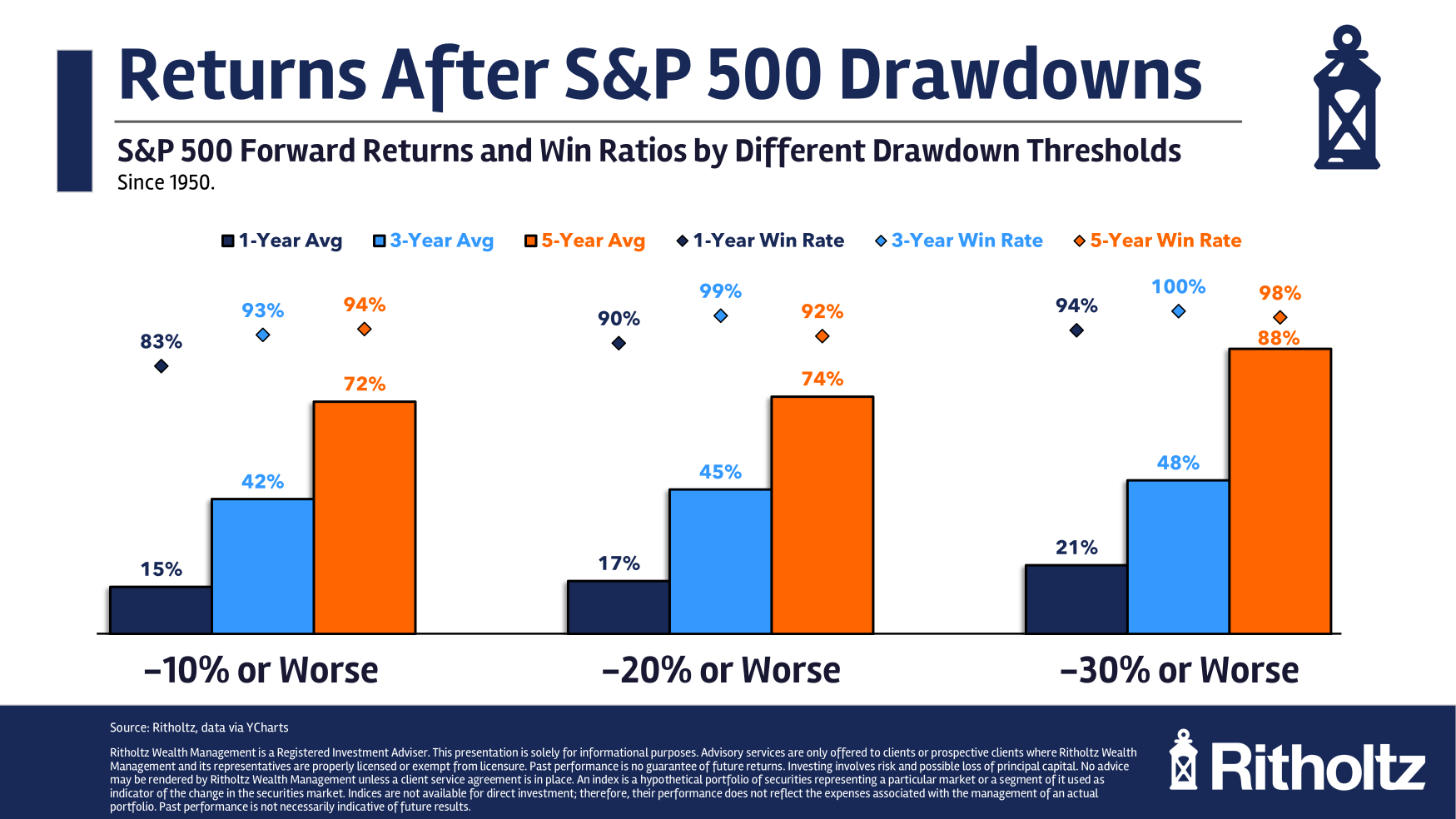
Ben Carlson put together an awesome chart showing returns following different levels of market drawdowns since 1950:
Let’s break this down.
Over the past 75 years or so, if every time the market dropped by 10% you decided to buy stocks, your average return would be:
- 15% after one year
- 42% after three years
- 72% after five years
If you decided to buy stocks every time the market dropped by 20%, your average return would be:
- 17% after one year
- 45% after three years
- 74% after five years
And if you decided to buy stocks every time the market dropped by 30%, your average return would be:
- 21% after one year
- 48% after three years
- 88% after five years
Historically speaking, the steeper the decline, the higher the expected forward returns. And we’re not talking about super long-term returns either. If you’ve invested after a 10%+ decline, your return over the following year has been much higher than the long-term average.
To use a recent market history as an example, after the 12% tariff-induced downturn in April of last year, the S&P 500 has since returned over 31% in under a year.
Even as I’m writing this on Tuesday, March 31st, the markets are shooting upward. The S&P 500, developed markets, and emerging markets are all up over 3% today. Which is a good reminder that markets are always moving.
Not only are downswings required for successful long-term investing, but they also present an opportunity to further grow your wealth.
Thanks for reading!

Jake Elm, CFP® is a financial advisor at Dentist Advisors. Jake a graduate of Utah Valley University’s nationally ranked Personal Financial Planning program. As a financial advisor at Dentist Advisors, he provides dentists with fiduciary guidance related to investments, debt, savings, taxes, and insurance. Learn more about Jake.