





Probably the most common phrase I hear uttered when having a conversation about the economy is:
“How do people afford this?”
And by “this,” they mean life.
I think this usually stems from people who feel they’re doing pretty well for themselves; they have a good job, a house, a car, and go on a vacation or two each year, maybe even saving a little. Yet, because of rising costs, the budget feels tight. They don’t feel like they’re getting ahead. And if they don’t feel like they can keep up, how does everyone else afford life?
Well, they can afford it because they’re rich. And there are a lot more rich people than you may think.
Economist Bryan Caplan recently published a breakdown of American net worth by age and percentile:
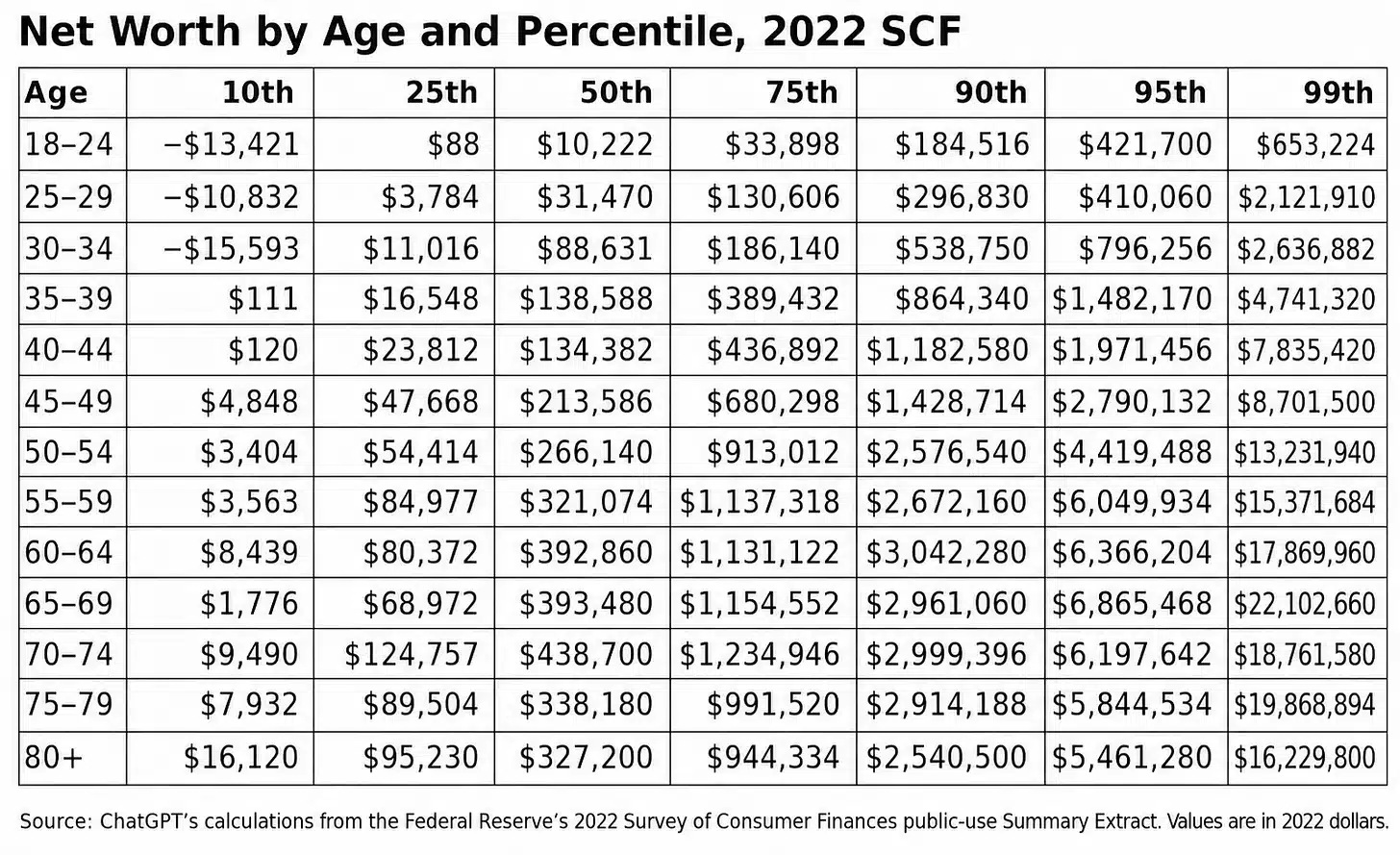
As a note, this data is from 2022, so it’s likely that nearly all of these numbers are a lot bigger now, with how house prices have grown and the stock market has performed over the past few years.
I don’t know about you, but to me, this data strongly opposes the “Americans are struggling” narrative. And it’s not just the elusive 1%.
The median American’s net worth crosses six figures by their mid-30s. Not the top 10%, the median. The person right in the middle of the pack.
Americans at the 75th percentile become millionaires by their mid-50s. Americans at the 90th percentile hit millionaire status around age 40.
Obviously, I’m not saying that financial hardship doesn’t exist for millions of Americans, but I think our cultural conversation about money and the economy is distorted. The average American is not struggling. Claims about the middle class who “can’t afford” groceries or gas are simply not supported by the data.
Half of all Americans who are 35 and older have hundreds of thousands of dollars in net worth. If you’re one of those people in that cohort and are still complaining about financial suffering, you probably don’t have an economic problem, but rather a psychological one. By almost all objective measures, you’re rich.
I like this insight from Caplan in the article:
Whatever your complaints about American capitalism, you’ve got to admit that a large share of Americans use the system to become staggeringly wealthy by the time they retire. Not 1% or 5%, but 25%.
Now, I do think a valuable insight from the data is that wealth is heavily tied to age.
Another phrase I’ll hear often is:
“I don’t know how young people are supposed to do it.”
They’re not. When have young people ever been rich? Isn’t the whole point of your 20s to try and figure out what you want to do with your life? Despite what social media may tell us, being poor when you’re young is very normal.
Yes, Americans aged 65-69 are worth roughly 30 times more than the wealthiest Americans aged 18-24. But that’s not necessarily an issue. It’s always been hard for young people to afford things. The key thing to understand is it’s typically not a permanent condition. It’s a phase.
I think the problem we run into is when we blur the line between “I can’t afford it right now” and “The system is rigged, and nobody can afford anything.”
One of those statements is a normal life stage. While the other just isn’t true.
In fact, the “system” has been quite good at rewarding people who get a job, save a little, and age a couple of decades.
Thanks for reading!

Jake Elm, CFP® is a financial advisor at Dentist Advisors. Jake a graduate of Utah Valley University’s nationally ranked Personal Financial Planning program. As a financial advisor at Dentist Advisors, he provides dentists with fiduciary guidance related to investments, debt, savings, taxes, and insurance. Learn more about Jake.